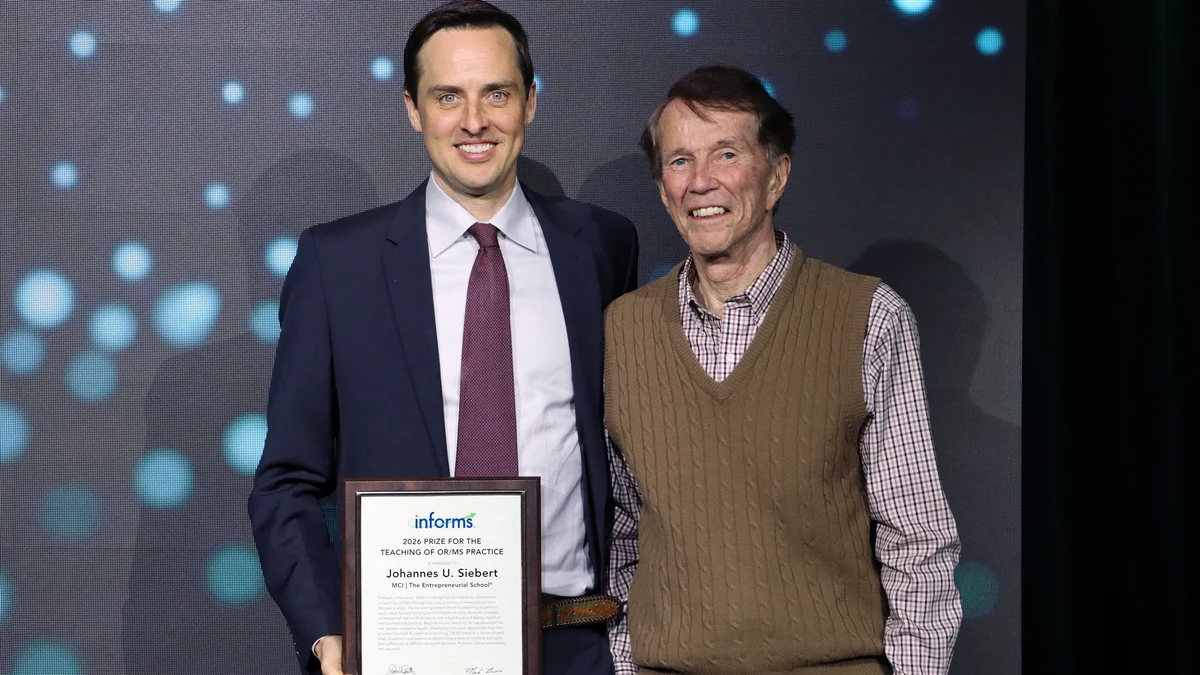
On 1 November, at the INFORMS Annual Meeting in San Francisco, I received the INFORMS Prize for the Teaching of OR/MS Practice. It is the first time the prize has gone to a teacher at a European institution. INFORMS is the world’s largest professional society for operations research and management science, and recognition from one’s own scholarly community carries particular weight.
What the prize is given for
The prize has been awarded since 1998, whenever the committee finds a suitable recipient, for excellence in teaching the practice of OR/MS. The call describes an effective practitioner as someone with “respect for, understanding of, and the skills to surmount both the practical difficulties and the technical challenges of doing good OR/MS work.”
That is an unusual combination. Technical competence alone is not enough, and neither is closeness to practice. What is honoured is what lies between: the ability to educate students so that they can actually work on difficult real decisions with the methods of the field – not merely describe them. My nomination reflected this: it included statements from former students who now work in practice – about what they do with the course years later.
In its citation, the committee recognises my teaching for preparing students to apply Value-Focused Thinking and multiattribute utility theory to complex, consequential real-world decisions, and adds:
“Beyond his own teaching, he has advanced the way decision analysis is taught, developing innovative approaches that have enriched the field.”
Citation, INFORMS Prize for the Teaching of OR/MS Practice 2026
What happens in the course
The course is built around the complete workflow of professional decision analysis: framing the decision, structuring objectives, developing alternatives from objectives, assessing consequences, eliciting preferences, testing robustness, and formulating a defensible recommendation.
Students do not go through this workflow once on a textbook example. They apply it to a real decision that they or their organisation actually face. Over the past seven years, more than 200 teams have done so, each documenting the work in a seminar paper and a complete, inspectable decision model.
They are not graded on whether the recommendation is supposedly right. They are graded on whether the path to it holds: the clarity of the frame, the separation of means from fundamental objectives, the operationalisability of the scales, the transparency of the trade-offs, the stability of the recommendation under changed assumptions. That is what professional decision analysis is measured against.
Where it began
It all began in 2013, when at my invitation Ralph Keeney taught a four-day course on Value-Focused Thinking at the University of Bayreuth – on a methodology he had by then been developing for four decades. Afterwards, he handed me his teaching materials and encouraged me to develop them further. Many of us guard our materials; Ralph handed his over. Over the years, they grew into the courses this prize is about. Ralph has since become my long-time mentor, co-author and friend – and it was he who nominated me. In his nomination letter, he writes:
“I know of no better courses in the world focusing on guiding and improving decision-making through the rigorous application of OR/MS methods – specifically value-focused thinking and multiattribute utility theory.”
Ralph L. Keeney, Duke University, in his nomination letter
The same method as in professional practice
The claim would be worth little if a simplified variant were taught in the lecture hall. It can be checked.
In a letter supporting the nomination, Mark Seidler, CEO of Strategic Decisions Group – co-founded in 1981 by Ronald A. Howard, the prize’s first recipient – stated that the methods taught meet the standards of professional decision analysis. The same software my students work with, Entscheidungsnavi ↗, was used at Bayer in preference-elicitation interviews with seven members of the executive committee, when more than fifty early-stage development projects had to be prioritised. Mark Seidler and I were among the co-authors of the case study in Decision Analysis.
Together with Ralph Keeney, I advised the California Department of Transportation on structuring the objectives for allocating its annual infrastructure budget; with Detlof von Winterfeldt, I worked on an objectives analysis for CREATE, funded by the U.S. Department of Homeland Security.
So there is no gap between course and practice – it is the same toolkit in different contexts.
What happens afterwards
The most telling evidence for teaching is what graduates do when nobody is grading any more. Former students have applied the approach years after graduation to decisions in companies, in public administration and in political bodies – to questions with several parties involved, incomplete data and competing objectives. That is where it shows whether a method has merely been understood or is actually available.
In parallel, my research with colleagues shows that these skills can be trained. A study in the European Journal of Operational Research documents significant training effects on proactive decision-making; a follow-up measurement about a year later showed no significant fade-out. A study I co-authored on a decision-analytical intervention for secondary school students received the Best Research Paper Award 2023 of the Decision Sciences Journal of Innovative Education.
Thanks
My thanks go to Ralph Keeney for the nomination, and for celebrating it with me in San Francisco; to Mark Seidler and everyone who supported it with their statements; and to MCI for the conditions that make such a demanding course possible. Above all to my former students: their work is the actual evidence this prize rests on.
References
Siebert, J. U.; Keeney, R. L. (2015). Creating More and Better Alternatives for Decisions Using Objectives. Operations Research, 63(5), 1144–1158.
Siebert, J. U.; Kunz, R.; Rolf, P. (2021). Effects of decision training on individuals’ decision-making proactivity. European Journal of Operational Research, 294(1), 264–282.
Methling, F. et al. (2022). Supporting Innovation in Early-Stage Pharmaceutical Development Decisions. Decision Analysis, 19(4), 337–353.
Siebert, J. U.; von Winterfeldt, D.; John, R. S. (2016). Identifying and Structuring the Objectives of ISIL and Its Followers. Decision Analysis, 13(1), 26–50.
Siebert, J. U.; Becker, M.; Oeser, N. (2023). Making a good career choice: A decision-analytical intervention to enhance proactive decision-making and career choice self-efficacy in high school students. Decision Sciences Journal of Innovative Education, 21, 10–25.
Entscheidungsnavi ↗