EDUCATION
Decision competence — teachable, transferable, evidence-based
Decision competence can be learned, developed and transferred across contexts. My teaching conveys decision competence as a methodological core skill — from the value-focused structuring of objectives to the deliberate handling of uncertainty and bias. Value-Focused Thinking and Decision Quality form the consistent thread that connects foundational teaching, research-led specialisation and continuing education into a coherent curriculum.

AWARDS
Award-winning teaching
2026
Federal Ministry of Women, Science and Research
2026
CEEMAN Champion Award – Teacher of the Year 2026
CEEMAN – International Association for Management Development in Dynamic Societies
2025
Shortlisted, European Award for Excellence in Teaching in the Social Sciences and Humanities
Yehuda Elkana Center for Teaching, Learning, and Higher Education Research
TEACHING CONCEPT
From knowledge to judgement
Students face decisions that rarely have a single right answer. Instead of analysing given cases, they design their own decision processes — structuring the problem themselves, developing alternatives and justifying their choice.
| Traditional case-based teaching Students work with pre-structured cases | This teaching concept Students design their own decisions |
| Problem given | › Structure the problem yourself |
| Alternatives given | › Develop alternatives |
| Discuss the solution | › Justify the decision |
| Focus on the result | › Focus on process quality |
This is how decision competence is not explained, but practised. Full description of the teaching concept in the Atlas of Good Teaching of the Austrian Federal Ministry of Women, Science and Research (in German) ↗
Structuring
Clarify the decision problem and objectives, make assumptions explicit and account for uncertainty.
Weighing
Weigh economic, social, environmental and ethical consequences transparently against one another.
Acting responsibly
Formulate well-founded recommendations, tolerate goal conflicts and communicate decisions appropriately.
EVIDENCE OF IMPACT
Not just taught — with measurable effects
Two peer-reviewed studies in the European Journal of Operational Research (sources below) show that proactive decision-making skills can be trained, with gains that were still present about one year later. A second study shows that these skills are associated with higher self-efficacy, decision satisfaction and, through these, life satisfaction.
Ø 1.11
Course evaluation across six cohorts (scale 1 = excellent; programme average 1.70)
d = 0.25–0.50
Effect sizes (Cohen’s d) across three decision-making courses; pooled d = 0.25
2,300+
Participants across two peer-reviewed EJOR studies
stable
No significant fade-out about one year after the course (follow-up cohort, n = 77)
IMPACT PATHWAY
Proactive decision-making skills
→
Self-efficacy
→
Decision satisfaction
→
Life satisfaction
Structural equation model from a cross-sectional study (three samples, N = 1,300): the association between proactive decision-making and life satisfaction is fully mediated by self-efficacy and decision satisfaction.
Sources: Siebert, Kunz & Rolf (2021), EJOR 294(1) · Siebert, Kunz & Rolf (2020), EJOR 280(3)
TEACHING INFRASTRUCTURE
Tools, courses and scalable learning formats
Three complementary formats extend decision education beyond individual courses — through digital decision support, self-paced learning and structured integration into higher education.
DECISION SUPPORT
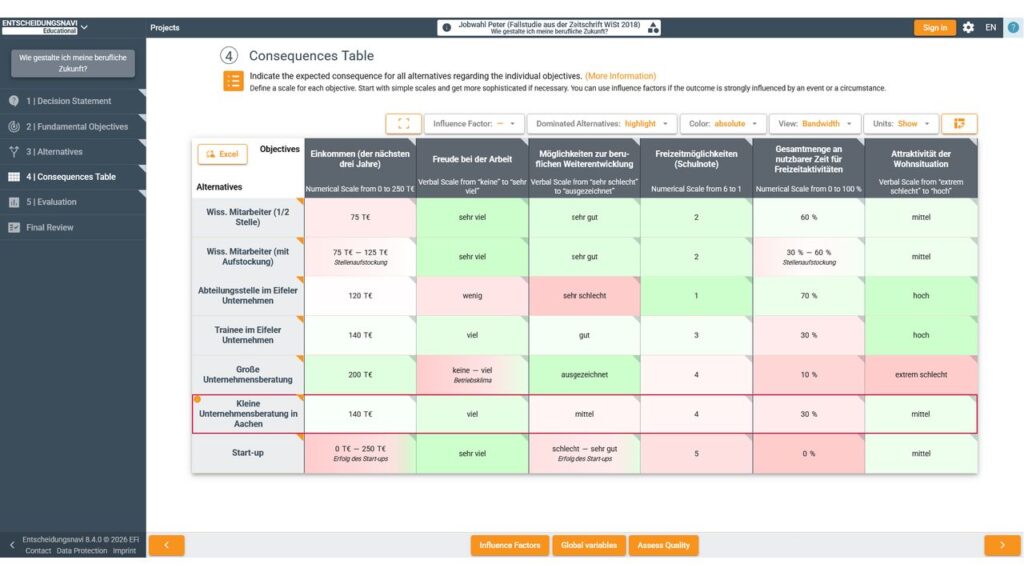
Entscheidungsnavi
With Rüdiger von Nitzsch (RWTH Aachen)
A web-based, openly accessible decision-support system. In teaching, it is the digital layer on which objectives, alternatives, data and preferences are brought together transparently.
10,000+ users
MOOC
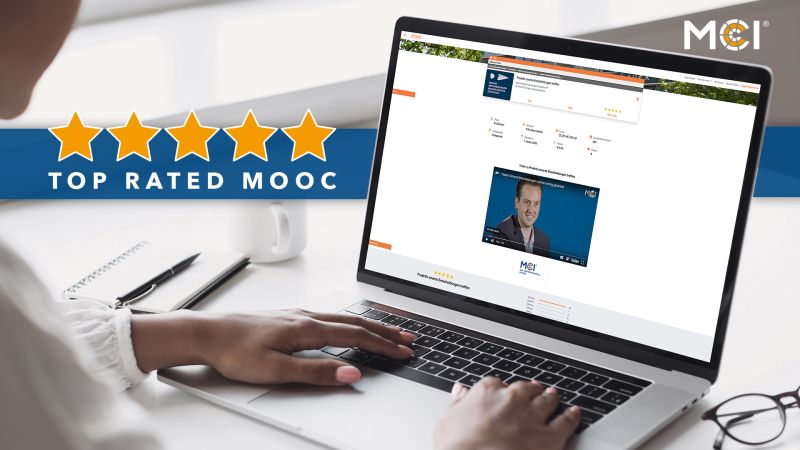
Proaktiv smarte Entscheidungen treffen
With Ralph L. Keeney (Duke University)
An open online course and the basis for the flipped-classroom format. It conveys Value-Focused Thinking as a self-paced learning path.
1,400+ participants · 4.98/5 · Top 3 iMooX
HIGHER EDUCATION
KLUGstudieren!
With Susan Pulham (htw saar)
A higher-education initiative that integrates decision competence into university learning and supports students in developing structured approaches to important academic, professional and personal decisions.
ACROSS ALL LEVELS
Dissemination and transfer
The method is not confined to individual courses. It is open, digitally supported and institutionally adaptable — from schools through higher education to public career guidance.
SCHOOLS
KLUGentscheiden!
Professional development that brings decision competence into teaching at secondary schools. Recognised by the Alliance for Decision Education as an international flagship project.
500+ teachers trained
HIGHER EDUCATION
Curricular integration of decision competence
Decision competence as a learning objective in higher education — with Sustainable Decision Making anchored as an AACSB Learning Goal and curricular integration across several Bachelor programmes.
250+ students per year
CONTINUING EDUCATION
Public institutions & career guidance
Decision competence for professional decision-makers: a two-day programme for an entire regional court of audit — and a three-day programme qualifying up to 5,000 career advisers.
Potential: 100,000+ young people per year