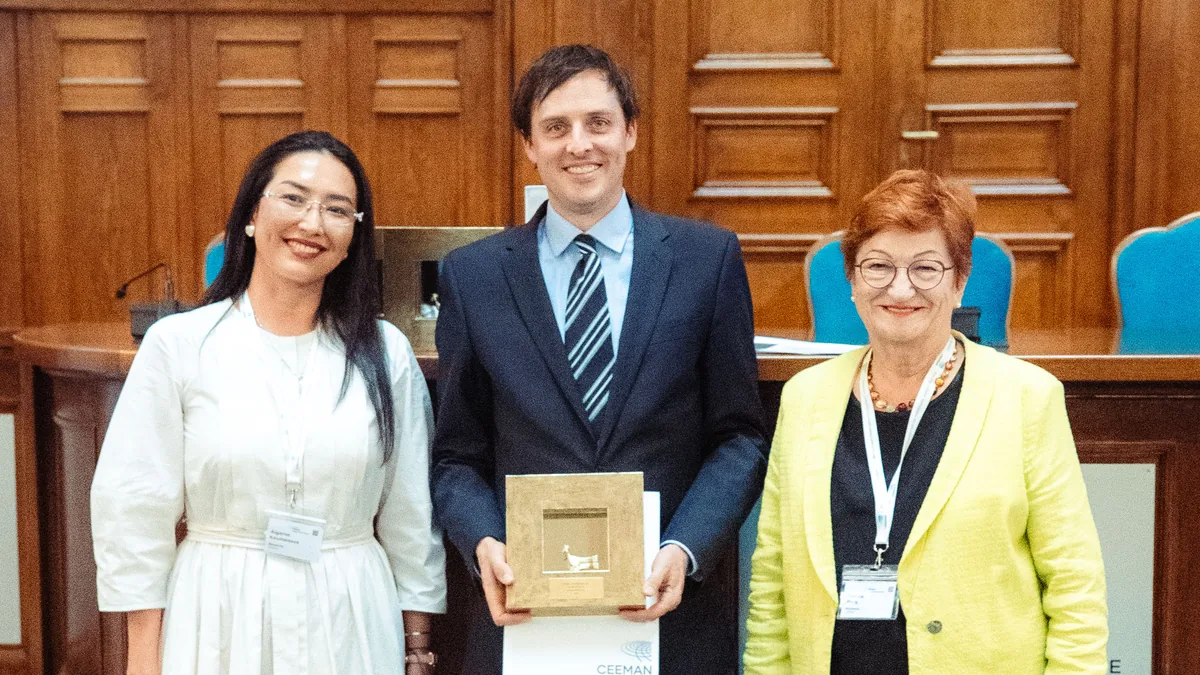
At the 34th CEEMAN Annual Conference in Bucharest I received the CEEMAN Champion Award in the category Teacher of the Year 2026. CEEMAN is an international association for management development with around 200 member institutions from more than 50 countries; its Champion Awards recognise achievement in teaching, research, responsible management education and institutional leadership.
What the jury highlights
One point stands at the centre of the citation, and it is the one that matters most to me as well: my students do not analyse prepared case studies but work on a decision that actually concerns them. They clarify their objectives, develop alternatives from them, assess consequences and weigh trade-offs deliberately. This is supported by Entscheidungsnavi, which I developed together with Rüdiger von Nitzsch.
Why the anchoring matters more to me than the course
A course that depends on one person ends with that person. A method that only works when its originator explains it is not a method but a person. And for students who do not take the course, it has no consequences — and they are always the majority.
That is why I am particularly glad this award does not refer to a single course. At MCI, decision-making competence is now treated across programmes as a competence in its own right and reviewed in the Assurance of Learning process. It is no longer my subject but the institution’s. Students encounter it regardless of whether they chose to.
Where this should lead
That is an intermediate step, not the goal. I regard decision-making competence as a future skill in the same sense as data literacy or academic writing: an ability every degree should convey, whatever the discipline.
The argument is straightforward. Everyone makes decisions during a degree and afterwards that shape what follows — about specialisations, first jobs, moving cities, later about responsibility for others. So far we assume people can do this. Training studies show they can learn it. Between the two lies a gap that universities could close.
What is missing is not a method — that exists. What is missing is the matter-of-factness with which we anchor other cross-cutting competences in the curriculum. That such anchoring works at one institution shows that it can be done.
And beyond the university
The same concepts underlie KLUGentscheiden!, an initiative to build decision-making competence among young people; more than 500 school teachers have been trained in it so far. They are also due to be used in public careers guidance, reaching several thousand advisors.
My thanks go to CEEMAN and the jury, to my colleagues at MCI who supported the curricular anchoring — and to the students, who bring their own decisions and thereby show whether the method is worth anything.
About the prize
CEEMAN Champion Award – Teacher of the Year 2026, presented by CEEMAN – International Association for Management Development in Dynamic Societies, at the 34th CEEMAN Annual Conference, 24th of September 2026 in Bucharest. → https://www.ceeman.org/competitions-awards/ceeman-champion-awards/champions-2026