Category: Media

  • Academic success begins before the first lecture

    Academic success begins before the first lecture

    Why students rarely leave because of the degree programme alone – and what universities should conclude from that.

    When students switch subjects or leave university, we usually look for the causes inside the degree programme: exam pressure, poor supervision, a bad fit. That falls short. Many of these trajectories have a prehistory that begins long before the first lecture. Young people make a far-reaching educational decision without ever having learned how to approach one systematically. In the current issue of Forschung & Lehre (9/2026) I argue that decision-making competence should not be treated as a remedial offer for the uncertain, but as a core academic competence.

    The real question comes before the comparison

    “I am torn between business administration and economics – but sports economics sounds interesting too.” The obvious next step is to compare degree programmes. The better question is: which decision is actually at stake here? “Which subject should I study?” triggers a different search process from “Which educational path fits my objectives, my abilities and the life I want?” The second question broadens the view: what is compared is no longer subjects, but paths into a desired future.

    Objectives first, alternatives second

    Once objectives are clear, the search for alternatives changes as well. It is no longer only about the subject a friend chose or the university nearby. Objectives help generate further alternatives and identify the information needed for a realistic assessment of consequences. What usually remains are trade-offs: academically attractive but far from home; good career prospects but few links to substantive interests. Such conflicts should not be suppressed but named explicitly.

    More information alone helps only so far. Anyone unable to structure their own decision situation does not automatically gain orientation from additional facts.

    Decision-making competence can be trained

    That is the good news. In important decisions, people typically identify only a fraction of their relevant objectives and alternatives – but these abilities can be strengthened deliberately. In a study published in the European Journal of Operational Research we showed that structured training produces a lasting improvement in proactive cognitive decision-making skills.

    A task for the whole system, not a single office

    If decision-making competence is a precondition for successful educational trajectories, it cannot rest on one office alone. It has to be fostered before university, taken up in advising and developed further during the degree. Through deadlines, elective structures, module architectures and programme descriptions, universities shape a decision architecture in any case – deliberately or not. Concrete starting points include modules in the first-year phase, reflection assignments in general studies, digital support for choosing specialisations, and structured formats in student advising and career services. These do not replace existing provision; they make it more effective.

    Leaving is not the same as failing

    A good university should not prevent every decision to leave. It should enable students to recognise in time whether they are on the right path. A well-founded choice may equally lead to a change of subject, a vocational training programme or direct entry into work. What matters is that the step is a considered one rather than a reaction to pressure. The problem is not the switch itself, but a switch that results from avoidable disorientation, unclear objectives or ignorance of relevant alternatives.

    Academic success does not begin with the first exam. It begins with the ability to choose one’s own educational path deliberately.

    About the article Siebert, J. U. (2026). Den Blick öffnen. Mit Entscheidungskompetenz durch Studium und Berufseinstieg. Forschung & Lehre, 9/26, 52–53. (in German) ↗ ; authorized English translation →
    References Siebert, J. U., Keeney, R. L. (2015). Creating More and Better Alternatives for Decisions Using Objectives. Operations Research, 63(5), 1144–1158. Siebert, J. U., Kunz, R., Rolf, P. (2021). Effects of decision training on individuals’ decision-making proactivity. European Journal of Operational Research, 294(1), 264–282.

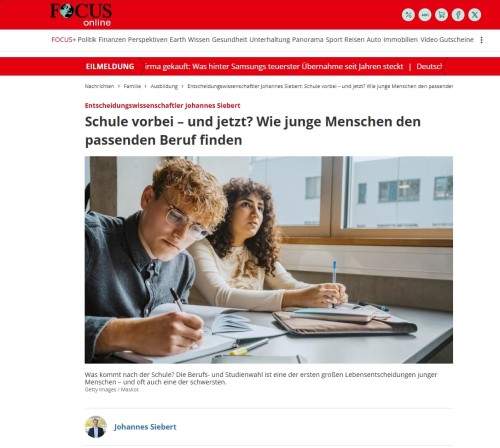
  • Decision scientist Johannes Siebert: School over – now what? How young people find the right career

    Decision scientist Johannes Siebert: School over – now what? How young people find the right career

    What comes after school? Choosing a career and course of study is one of the first significant decisions young people make in life—and often one of the most challenging. Decision scientist Prof. Johannes Siebert explains why it is more than just a “compulsory program” and what opportunities it offers.

    Many young people are currently asking themselves: “What am I going to do after school?” Why is this decision so important?

    For many of them, choosing a career or course of study is one of the first significant decisions they must make independently. It not only influences their professional career, but also their self-confidence and their prospects. In short: their lives. It is often possible to change the initial decision to study or do vocational training without a great deal of bureaucracy.

    However, as surveys show, this often results in considerable individual psychological stress for young people – not to mention the overall economic consequences, such as an increased shortage of skilled workers and lower economic productivity due to delayed career entry.

    Read the full article here (in German): https://www.focus.de/familie/ausbildung/entscheidungswissenschaftler-johannes-siebert-schule-vorbei-und-jetzt-wie-junge-menschen-den-passenden-beruf-finden_22435455-3583-4c2a-8981-3b80dd727a0b.html

    Please stay current and do not miss any of my contributions on Focus Online. Follow me and network with me for exciting insights and current discussions. I look forward to exchanging ideas with you! https://www.linkedin.com/in/johannes-siebert/

  • Sound decisions are the key

    Sound decisions are the key

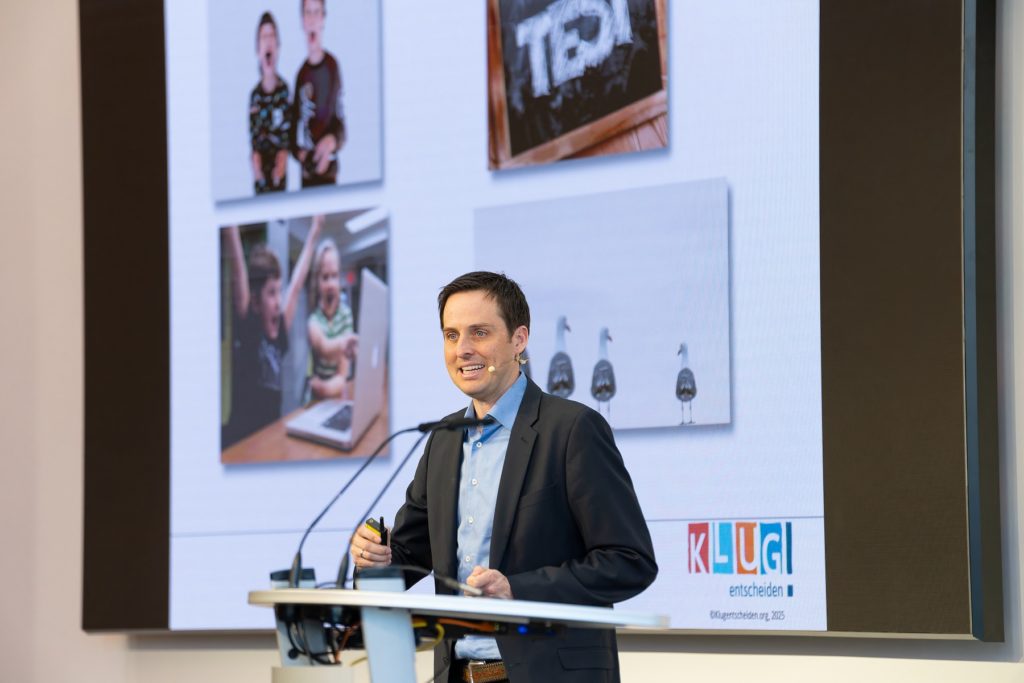
    At the second Education Summit of the Employers’ Associations of Lower Saxony I spoke about the question career orientation usually skips: young people learn a great deal about which paths exist – and almost nothing about how to choose between them.

    Talk: Sound decisions are the key – Career orientation through decision analysis
    Event: 2nd UVN Education Summit, “Career orientation as the key to success”
    Date and venue: 19 March 2025, Karriere-Campus Hannover
    Host: Unternehmerverbände Niedersachsen e.V. (UVN)
    Event page (UVN)  ·  Recording of the summit

    Around 250 guests from business, schools and politics came together at the Karriere-Campus in Hannover. The political line-up showed how much weight the topic carries in Lower Saxony: two state ministers took part – Minister of Education Julia Willie Hamburg and Minister of Economic Affairs Olaf Lies, now Minister-President of the state.

    Postponing is a decision too

    Roughly one in three young people drops out of vocational training or university study shortly after starting – with consequences for the skills shortage and a considerable burden on the individuals themselves. One reason is rarely named: many young people see decisions as problems to be solved. Solving problems is unpleasant, so they put it off. At some point the window closes and only the leftovers remain. Or they do “nothing for now” – and the first “nothing for now” is usually followed by a second.

    We need to inspire young people not only about careers, but about choosing one.

    Decision competence is the missing building block

    Internships, aptitude tools, careers fairs, open days: the existing offerings achieve a great deal, and they have one thing in common – they widen the range of choices. What they cannot do is make the choice. That requires the ability to decide independently and on a sound basis. Decision competence therefore does not compete with established career orientation; it is the building block that makes it effective.

    I illustrated this with KLUGentscheiden, which I initiated as a research project at the University of Bayreuth. Using methods from decision analysis, we break a student’s decision down into manageable steps together with them: clarify objectives, develop alternatives, bring the two together. Our digital tool KLUGnavi supports the analysis. The evaluation shows that afterwards students perceive the choice of career or study programme as less difficult and rate themselves as more proactive and more self-efficacious (Siebert, Becker & Oeser, 2023, Decision Sciences Journal of Innovative Education 21(1), 10–25).

    The bottleneck is anchoring it in schools

    Teachers’ interest is considerable – in Bavaria alone we have trained more than 400 of them as multipliers, and the materials are available free of charge. The real hurdle comes afterwards: it is precisely the most committed teachers who meet resistance when they try to establish the programme permanently at their school.

    Saarland shows how it can work. There, “KLUGentscheiden! goes Saar” – funded by the statutory health insurance funds and run together with the Landesamt für Pädagogik und Medien and the Ministry of Education and Culture – is working on exactly that until 2027: adapting the materials to different timetable formats, qualifying teachers through train-the-trainer sessions, and handing delivery over to the schools themselves. That kind of structural anchoring is what is needed – and it is what I spoke about in Hannover.

    More on materials and teacher training: klugentscheiden.org

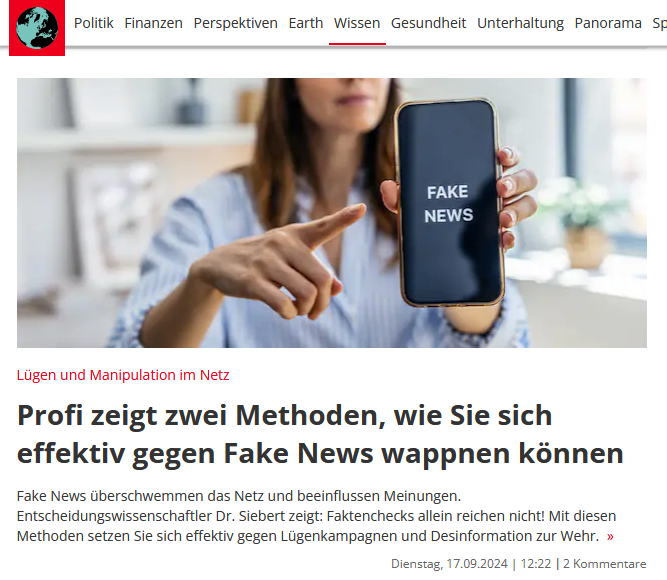
  • Lies and manipulation on the internet: expert shows you two effective ways to protect yourself against fake news

    Lies and manipulation on the internet: expert shows you two effective ways to protect yourself against fake news

    Fake news is deliberately spread to manipulate opinions and, thus, elections. Fact checks alone are powerless against their public effectiveness. However, in combination with other tools, resistance to false claims can be strengthened in the long term.

    “You can fool all of the people some of the time and some of the people all of the time, but you can’t fool all of the people all of the time,” declared US President Abraham Lincoln more than 150 years ago. Even though he was already vividly aware of the influence of fake news on public opinion back then, he was confident enough to believe that the truth would prevail in the end – at least for most people. Can we still share this optimism in the age of internet media that is prone to manipulation and its global networking?

    Despite prominent experiences to the contrary, resignation is clearly out of place. A large number of scientific studies have recently examined the effects of fake news and developed effective countermeasures. The results are cause for concern, but they also show that we are by no means defenseless against the seductive power of fake news. Perhaps just reading this article can help you react more consciously and resiliently in the future to campaigns that aim to persuade you to believe something you would never think on your own.

    Read the full article here (in German): https://www.focus.de/experts/profi-zeigt-zwei-methoden-wie-sie-sich-effektiv-gegen-fake-news-wappnen-koennen_id_260161530.html

    Please stay current and do not miss any of my contributions on FOCUS Online. Follow me and network with me for exciting insights and current discussions. I look forward to exchanging ideas with you! https://www.linkedin.com/in/johannes-siebert/

  • Generation A – Making decisions easier for young people

    Generation A – Making decisions easier for young people

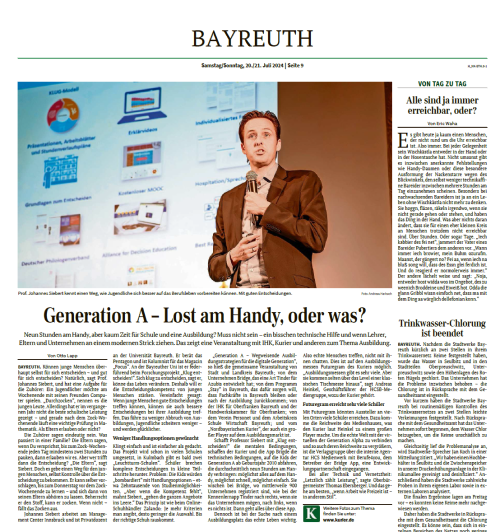
    BAYREUTH. Can young people even make decisions for themselves – and make good decisions for themselves? Of course, says Prof. Johannes Siebert, and has a task for the audience: a young person wants to play computer games with his friends on the weekend. The young people call it “gaming”. However, he has not performed the best at school in the past year, and there is a critical math exam just after the gaming weekend. Should parents allow it or not? The listeners clearly say no. What happens in a family? The parents say, if you promise to cram for at least two hours every day until the Zock weekend, then we’ll allow it. But who makes the decision? “The parents,” says Siebert. But there is a way for young people to gain control over the decision themselves. They can suggest that they study until Thursday before the gambling weekend – and then have their parents listen to them. If he has mastered the material, he can take a risk. If not, no gambling.

    Johannes Siebert works at the Management Center Innsbruck and is a private lecturer at the University of Bayreuth. He advises the Pentagon and is a columnist for Focus magazine. At the University of Bayreuth, he is responsible for the “Klug entscheiden!” research project. He says that making smart decisions can change your life. That’s why he wants to strengthen young people’s decision-making skills. Put simply, if young people can make good decisions, they can also make better decisions in their educational pursuits. This leads to fewer young people dropping out of training, fewer failures, and they become happier.

    Fewer options desired

    Sounds simple and is easier than expected. The project is already being implemented in many schools, and there will soon be two “lighthouse schools” in Kulmbach. Pupils break down complex decisions into small steps. Problem: The kids are “bombarded” with options for action, such as tens of thousands of study options. “But if they don’t have the skills,” warns Siebert, “all the options go nowhere, come to nothing.” The principle is similar to that of online shoe retailer Zalando: the more criteria you specify, the smaller the selection. Until the right shoe comes out……

    The complete, excellent article by chief reporter Otto Lapp from the Nordbayerischen Kurier can be found here: https://www.kurier.de/inhalt.generation-a-lost-am-handy-oder-was.210c70c8-81d9-4def-a5a3-b36ea31fb743.html

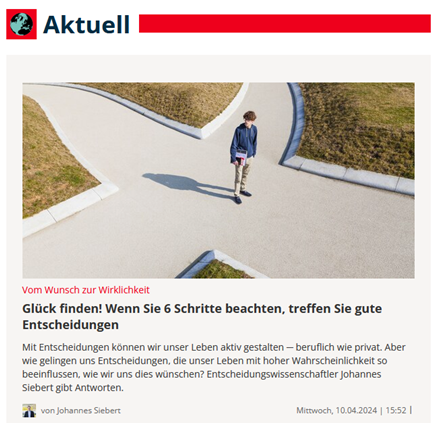
  • From wish to reality: Find happiness! If you follow 6 steps, you will make good decisions

    From wish to reality: Find happiness! If you follow 6 steps, you will make good decisions

    We can actively shape our lives through our decisions ─ both professionally and personally. But how do we make decisions that are likely to influence our lives in the way we want them to? Decision scientist Johannes Siebert provides answers.

    We often invest a lot of time and energy in important decisions. Nevertheless, sometimes we are dissatisfied with ourselves afterward. But when is self-criticism justified? What makes a good decision anyway?

    Only when we are clear about how we can make good decisions can we increase our own life satisfaction through our actions.

    First of all, a key point: the results of our decisions are not a criterion for their quality. Although we can influence the future, it is never entirely up to us how it turns out. There is always a residual uncertainty.

    Imagine we decide to travel to a destination known for its white sandy beaches and reliably sunny weather in the summer months. Then, we experience heavy rain showers, cold winds, or tanker accidents that pollute the beach.

    Did we make a wrong decision because of this? No, because we could neither foresee nor influence any of this when we made our decision.

    Instead, the quality of our decisions depends on six elements that are primarily within our own control and that interlock like the links in a chain. The following applies: the decision can never be better than the weakest link in the chain. It is, therefore, worth striving for the highest possible quality in all of the following six elements!

    Read the full article here (in German): https://www.focus.de/experts/vom-wunsch-zur-wirklichkeit-yes-we-can-mit-diesen-6-schritten-finden-sie-ihr-persoenliches-glueck_id_259842310.html

    Please stay current and not miss any of my contributions on FOCUS Online. For exciting insights and current discussions, follow me and network with me. I look forward to exchanging ideas with you! https://www.linkedin.com/in/johannes-siebert/

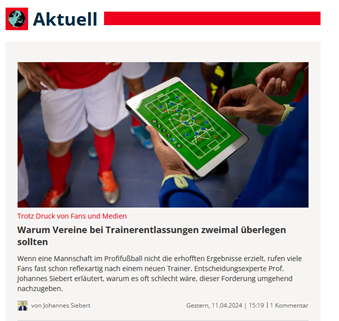
  • Despite pressure from fans and the media: why clubs should think twice when sacking coaches

    Despite pressure from fans and the media: why clubs should think twice when sacking coaches

    When a team in professional soccer fails to achieve the hoped-for results, many fans almost reflexively call for a new coach. In my article on Focus Online, I explain why it is often a bad idea to give in to this demand.

    A team is behind and needs two goals in the last quarter of an hour to turn the game around. In this critical situation, the coach decides to substitute a striker for a defender. The striker scores the two long-awaited goals and the team wins. Was the substitution of the striker a good decision by the coach? Many fans, commentators, and media clearly say “Yes!”. In the event of a defeat, they would have vehemently demanded the dismissal of the coach, whom they are now celebrating for his tactical foresight. In terms of decision-making theory, this reaction—although understandable at first glance—does not make sense.

    This becomes clear with a counterexample. Let’s assume Dietmar Hamann, who has long since ended his active career and works as a television pundit, is eligible to play and is sitting on the substitutes’ bench ready for action. He is substituted by the coach a quarter of an hour before the end of the game, an opponent’s clearance hits him on the back, and the ball bounces into the goal. A few seconds before the final whistle, there is a similar scene. Dietmar Hamann scores the redemptive goal. The team is victorious. Was it a good decision to substitute the “soccer pensioner” Hamann? Certainly not. But perhaps the coach could have made a decision that was more likely to win.

    At Bayern Munich, for example, Jupp Heynckes and Pep Guardiola would sometimes use the firm defender Daniel van Buyten as a tactical measure in the center of the attack, rather than replacing him with another striker. Van Buyten tied up two opponents, thus creating space for his teammates. Coaches are less celebrated by fans and the media for such measures. The reason for this is that the result of the decision is not directly linked to the coach’s decision, as would be the case if a substitute scored a goal.

    Read the full article here (in German): https://www.focus.de/experts/entscheidungsexperte-warnt-warum-vereine-bei-trainerentlassungen-zweimal-ueberlegen-sollten_id_259845761.html

  • Realize your dreams through sound decision making

    Realize your dreams through sound decision making

    In an article in the FOCUS Online Expert Circle, I explain the biggest mistake made in decision-making and how to easily avoid it.

    The biggest mistake is that many people are content with the default decision-making situations and don’t actively engage with what they should (actually) be deciding on. It’s essential to think outside the box and (pro-)actively take control of our own decisions.

    And there is hope! Proactive decision-making is a skill that anyone can learn. A practical approach is to think through every decision-making situation with three key questions in mind:

    1. How can we best define decision-making situations?

    2. How can we identify the objectives relevant to a decision?

    3. How do we discover excellent options for action?

    I answer these and other questions in the interview. Read the full article here: https://www.focus.de/experts/fundierte-entscheidungsfindung-stellen-sie-sich-drei-schluesselfragen-um-traeume-zu-verwirklichen_id_259706293.html

    I also discuss the importance of being your own decision architect—a concept I explore in more depth in my TEDx Talk.

    English TEDxTalk: https://bit.ly/TEDxTalkSiebert

    German translation: https://bit.ly/TEDxTalkText

    Looking for more in-depth insights? My free online course “Proactively making smart decisions” is waiting for you with comprehensive material – ideal for a rainy February. Discover strategies for making smart decisions and expanding your horizons from the comfort of your own home. Register now and take the opportunity to expand your knowledge!

    Discover the course: https://imoox.at/course/smartentscheiden

    I was hoping you could stay up to date and not miss any of my posts in the FOCUS Online Expert Circle. Follow me and network with me for exciting insights and current discussions. I look forward to exchanging ideas with you!

  • MCI-Prof. Johannes Siebert wins prestigious Best Paper Award

    MCI-Prof. Johannes Siebert wins prestigious Best Paper Award

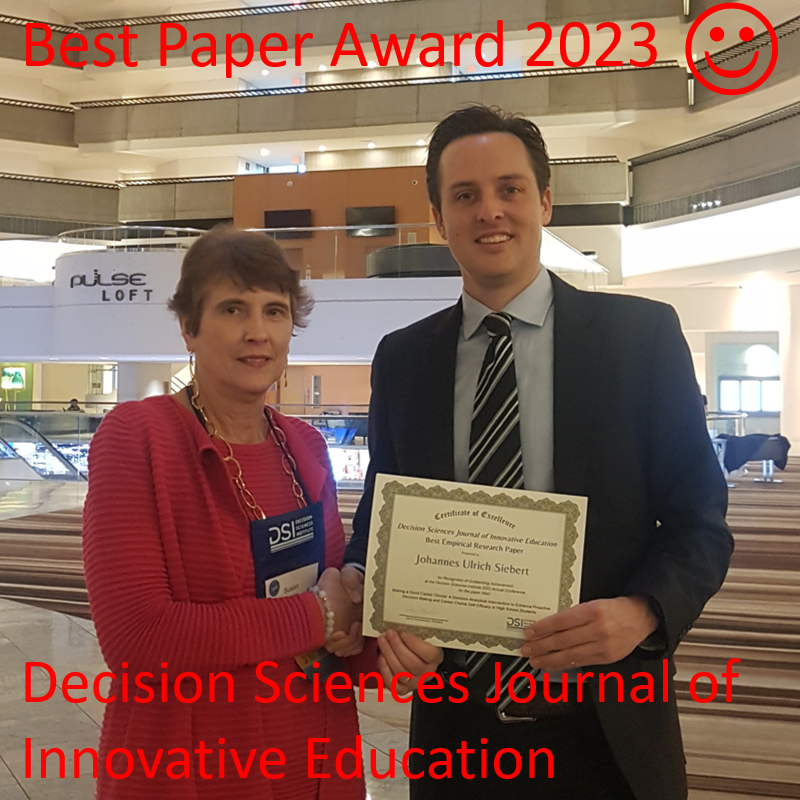
    We are delighted that the article “Making a good career choice: A decision-analytical intervention to enhance proactive decision-making and career choice self-efficacy in high school students” by Prof. Johannes Siebert, Dr. Nadine Oeser, and Dr. Maxi Becker was awarded the Best Research Paper 2023 by the renowned Decision Sciences Journal of Innovative Education. In previous studies, Siebert/Kunz/Rolf (2020, 2021) demonstrated the effectiveness of decision-making skills training for students and managers. Taken together, the studies allow the conclusion that proactive cognitive decision-making skills can be improved through decision-making skills training and, as a result, participants experience greater self-efficacy and are more satisfied with their lives. Motivated by these research results, Prof. Siebert wanted to investigate the effectiveness of KLUG-decision-making competence training in analogy to these studies.
    Further details can be found here: https://www.mci.edu/en/news-filter-en/193-studyprogram-news/news-business-management-en/5453-best-paper-award-decision-sciences
  • What is important when it comes to career guidance at school: researchers explain how best to support pupils in choosing a course of study or training

    The drop-out rates among trainees and first-year students are high – on average, around one in four drop out again. Schools play a crucial role in providing career guidance. Prof. Dr. Johannes Siebert from the Management Center Innsbruck explains which mistakes should be avoided.

    You can find the full, excellent article by Lena Sterz from Campus Schulmagazin here: https://www.campus-schulmanagement.de/magazin/was-bei-der-berufsorientierung-in-der-schule-wichtig-ist