Category: Award

  • What remains when I am not in the room

    What remains when I am not in the room

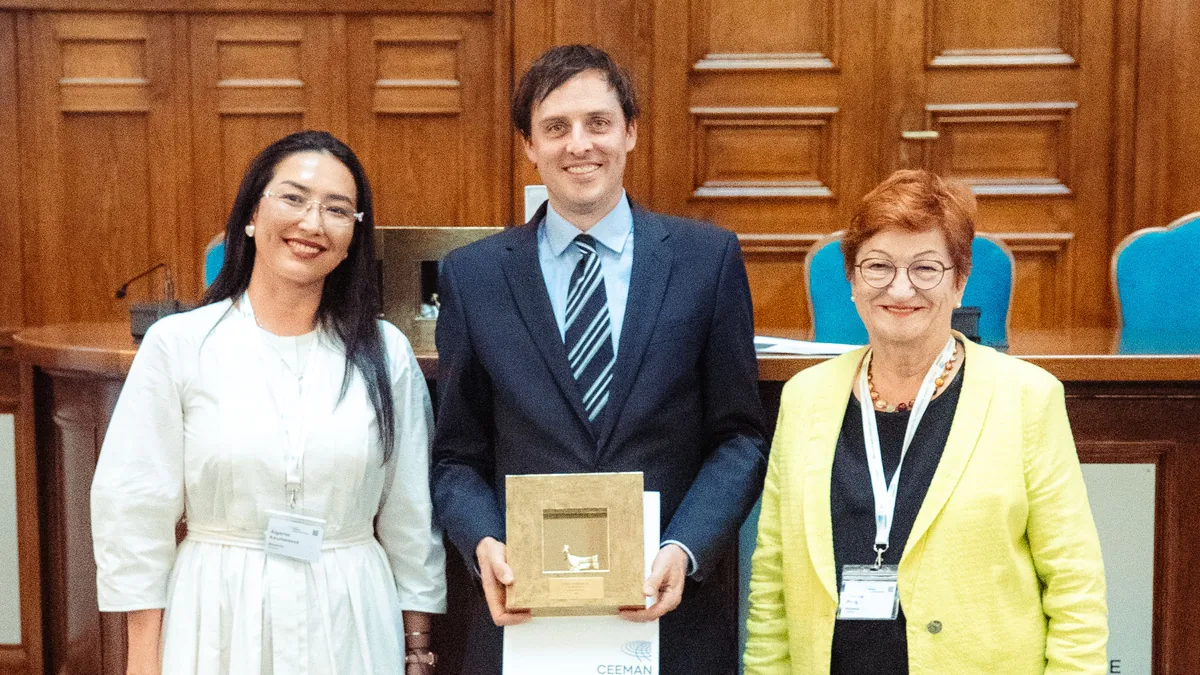
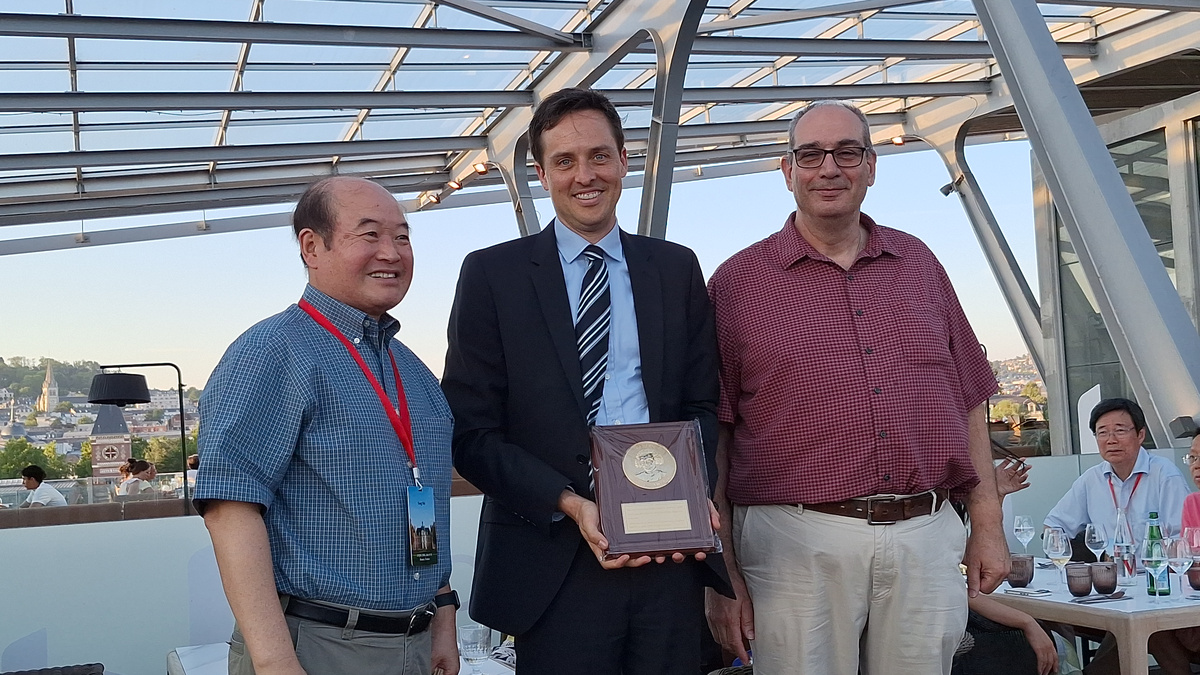
    At the 34th CEEMAN Annual Conference in Bucharest I received the CEEMAN Champion Award in the category Teacher of the Year 2026. CEEMAN is an international association for management development with around 200 member institutions from more than 50 countries; its Champion Awards recognise achievement in teaching, research, responsible management education and institutional leadership.

    What the jury highlights

    One point stands at the centre of the citation, and it is the one that matters most to me as well: my students do not analyse prepared case studies but work on a decision that actually concerns them. They clarify their objectives, develop alternatives from them, assess consequences and weigh trade-offs deliberately. This is supported by Entscheidungsnavi, which I developed together with Rüdiger von Nitzsch.

    Why the anchoring matters more to me than the course

    A course that depends on one person ends with that person. A method that only works when its originator explains it is not a method but a person. And for students who do not take the course, it has no consequences — and they are always the majority.

    That is why I am particularly glad this award does not refer to a single course. At MCI, decision-making competence is now treated across programmes as a competence in its own right and reviewed in the Assurance of Learning process. It is no longer my subject but the institution’s. Students encounter it regardless of whether they chose to.

    Where this should lead

    That is an intermediate step, not the goal. I regard decision-making competence as a future skill in the same sense as data literacy or academic writing: an ability every degree should convey, whatever the discipline.

    The argument is straightforward. Everyone makes decisions during a degree and afterwards that shape what follows — about specialisations, first jobs, moving cities, later about responsibility for others. So far we assume people can do this. Training studies show they can learn it. Between the two lies a gap that universities could close.

    What is missing is not a method — that exists. What is missing is the matter-of-factness with which we anchor other cross-cutting competences in the curriculum. That such anchoring works at one institution shows that it can be done.

    And beyond the university

    The same concepts underlie KLUGentscheiden!, an initiative to build decision-making competence among young people; more than 500 school teachers have been trained in it so far. They are also due to be used in public careers guidance, reaching several thousand advisors.

    My thanks go to CEEMAN and the jury, to my colleagues at MCI who supported the curricular anchoring — and to the students, who bring their own decisions and thereby show whether the method is worth anything.

    About the prize

    CEEMAN Champion Award – Teacher of the Year 2026, presented by CEEMAN – International Association for Management Development in Dynamic Societies, at the 34th CEEMAN Annual Conference, 24th of September 2026 in Bucharest. → https://www.ceeman.org/competitions-awards/ceeman-champion-awards/champions-2026

  • Decision-making competence can be taught – and tested

    Decision-making competence can be taught – and tested

    On 8 September I received the Ars Docendi Anerkennungspreis – the recognition award of the Austrian Federal Ministry of Women, Science and Research – in Vienna, in the category “socially and sustainability-oriented teaching”, for the course design “From subject knowledge to judgement: developing decision-making competence systematically”. I am glad about the recognition. What matters more to me is the question behind it: why do we assume so readily in higher education that students can decide – and teach it so rarely?

    What happens in the course

    Over one semester, students work on real decision problems from business, politics and society: from logistics strategies to sustainability- and technology-related challenges. They clarify their objectives, develop courses of action, compare economic, social and environmental effects, and derive a reasoned recommendation.

    The difference from a classical case study lies at the very beginning. In a case study the problem is given and the analysis is open; here it is the other way round. Students first have to work out which decision is actually at stake and which objectives are attached to it. Only then does the methodological toolkit pay off.

    Not a didactic aspiration but a testable claim

    Students should not learn to reproduce supposedly correct answers, but to make defensible decisions under uncertainty. Decision-making competence can be learned, examined and measured. This is not a programme statement: it shows up in the course evaluations.

    Embedded in the curriculum, not offered as an elective

    A course design only takes effect if it does not depend on the accident of course selection. At MCI, “Responsible Decision Making” is one of the learning goals of the bachelor programmes and is reviewed within the Assurance of Learning process of the accreditation body AACSB. The award-winning design is embedded in six bachelor programmes, so it reaches more than those who are interested anyway.

    What students take away

    “What I learned in this course I still apply today. I approach complex decisions differently than before – more structured, and with more clarity about what actually matters to me.” Julian Pfurtscheller, Chair of the MCI student union and a former student

    What the award says – and what it does not

    The Ars Docendi Anerkennungspreis honours a single course design. That is a different object from the recognitions that have come in the same period. CEEMAN, the international association for management development, presented me with the Champion Award in the category “Teacher of the Year 2026” in Bucharest on 24 September; that award refers to teaching performance as a whole. The Society of Decision Professionals recognised my engagement in advancing and applying decision analysis with the Inspirational Achievement Award, and the International Academy of Information Technology and Quantitative Management recognised my research with the Richard Price Award.

    Four awards, four different objects. What connects them is the conviction that deciding is an ability, not a character trait.

    Learning to decide does not make you more certain. It makes your choices better founded.

    About the award

    Ars Docendi – Austrian State Prize for Excellence in Teaching. Recognition award (Anerkennungspreis) in the category “socially and sustainability-oriented teaching”, presented by the Federal Ministry of Women, Science and Research in Vienna on 8 September 2026. Official Award Profile ↗   ·   Press release ↗  

  • Richard Price Award for MCI Professor Johannes Siebert

    Richard Price Award for MCI Professor Johannes Siebert

    Recognition for contributions to Data Science and its application in planning and prioritization decisions

    Johannes Siebert, Professor of Decision Sciences, Behavioral Economics and Supply Chain Management at MCI | The Entrepreneurial School®, has received the Richard Price Award from the International Academy of Information Technology and Quantitative Management (IAITQM) and has also been elected a “Fellow” of the Academy. The award was presented at the 13th International Conference on Information Technology and Quantitative Management (ITQM 2026) in Rouen. The Richard Price Award honors individuals who have made outstanding contributions to the theory, methodology and application of Data Science. The award is named after Richard Price, whose posthumous publication of Bayes’ theorem laid a foundation for modern data-based inference.

    With the award, IAITQM recognizes Siebert’s work at the interface of Data Science and decision-making. His research program combines data-driven and AI-supported approaches with multicriteria decision methods and provides methodologically sound, empirically validated approaches for translating analytical results into well-founded resource and capital allocation decisions under uncertainty. The practical value of this approach is demonstrated by applications in industry and the public sector. For Bayer AG, Siebert contributed, together with Strategic Decisions Group, to the development of a model for prioritising the early-stage development pipeline (published in Decision Analysis, 2022). The project was a 2020 finalist for the Practice Award of the Decision Analysis Society (INFORMS); in total, Siebert has been a finalist for this award three times. In 2014, together with Ralph L. Keeney, he advised the California Department of Transportation (Caltrans) in the framing phase of a pilot project on prioritising highway and bridge projects worth around USD 2.3 billion a year at the time.

    “Data Science is fundamentally changing how decisions are made – at the same time, the importance of structured, value-focused decision processes has never been greater. This recognition encourages me to continue advancing this field in research, practice and teaching,” says Johannes Siebert.

    At MCI, Siebert conducts research and teaches in data-based decision-making, Business Analytics, Behavioral Economics and multicriteria methods, with a particular focus on the role of Artificial Intelligence in entrepreneurial planning, prioritization and control decisions. This orientation strengthens innovation, digitalization and future-oriented capabilities in academia and business alike. Beyond research, Siebert brings his findings into decision education programs, thereby extending the impact of decision competence beyond the university.

    “This recognition underscores the international significance of MCI research in the fields of Entrepreneurship and Decision Making. It shows that innovative research on entrepreneurial action and intelligent decision-making is recognized worldwide and sustainably strengthens MCI’s international reputation,” adds MCI-Head of Research & Development Martin Pillei.

    Siebert’s academic references include a paper co-authored with Ralph L. Keeney (Duke University) in Operations Research, one of the world’s leading journals in the field. His work has also received extensive international recognition: the Inspirational Achievement Award of the Society of Decision Professionals (SDP), the Best Research Paper Award of the Decision Sciences Journal of Innovative Education (2023), finalist status for the European Award for Excellence in Teaching in the Social Sciences and Humanities, and a TEDx talk with more than 175,000 views.

    The original press release can be found here: https://www.mci.edu/en/news-filter-en/117-studyprogram-news/276-news-business-management-for-professionals/7387-richard-price-award-for-mci-professor-johannes-siebert

    Official sources: IAITQM Award Page · MCI Press Release

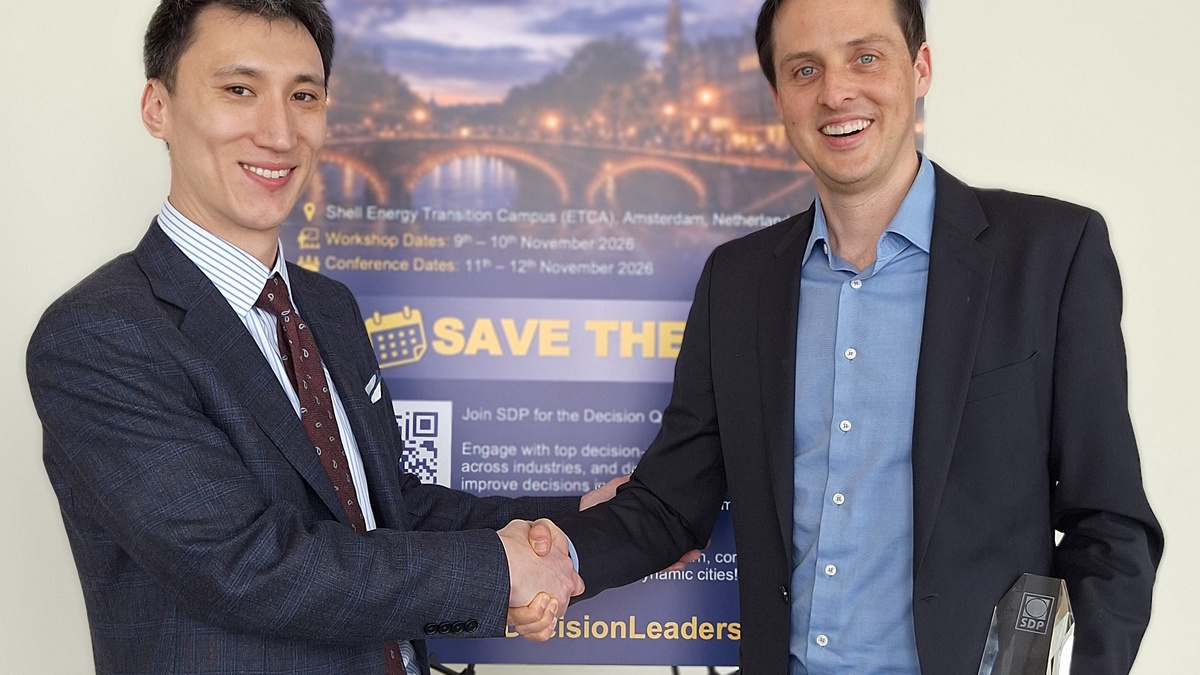
  • MCI Professor Johannes Siebert Receives Prestigious SDP Award

    MCI Professor Johannes Siebert Receives Prestigious SDP Award

    International recognition honors outstanding contributions to data-driven decision-making, supply chain management, and societal impact | Award presented at the 32nd SDP Annual Conference at the University of Massachusetts in Boston

    Johannes Siebert, Professor of Decision Sciences, Behavioral Economics, and Supply Chain Management at MCI, has been honored with the “Inspirational Achievement Award” by the Society ofDecision Professionals (SDP). This internationally renowned award was presented during the 32nd SDP Annual Conference at the University of Massachusetts in Boston, recognizing exceptional achievements in decision analysis and outstanding commitment to advancing the field.

    At MCI, Johannes Siebert conducts research and teaching in the field of decision analysis, with a strong focus on data-driven decision-making, behavioral economics, and multi-criteria methods. A particular emphasis lies on the role of artificial intelligence in decision processes, as well as on making decision quality measurable and trainable – key aspects in fostering innovation, digitalization, and future competencies in both academia and industry.

    “Decision science is at a turning point: artificial intelligence is transforming how decisions are made. However, at the same time, the importance of structured, value-focused decision processes has never been greater. This award strongly motivates me to further advance the field across research, practice, and teaching,” says Johannes Siebert.

    Johannes Siebert regularly contributes his expertise to international applied projects for both private and public sector partners, including initiatives in the energy, transportation, and pharmaceutical industries. His achievements have earned him multiple nominations for the Practice Award of the Decision Analysis Society. His excellence in teaching has also received international recognition, including a finalist nomination for the highly regarded European Award for Excellence in Teaching in Social Sciences and Humanities.

    MCI Rector Andreas Altmann adds: “This award highlights what MCI stands for: excellence in research, strong practical orientation, and active engagement with key societal challenges. Johannes Siebert exemplifies these values and strengthens MCI’s international reputation as a leading institution in decision sciences and management education.”

    The original press release can be found here: https://www.mci.edu/en/media-en/news/7127-mci-professor-johannes-siebert-receives-prestigious-sdp-award

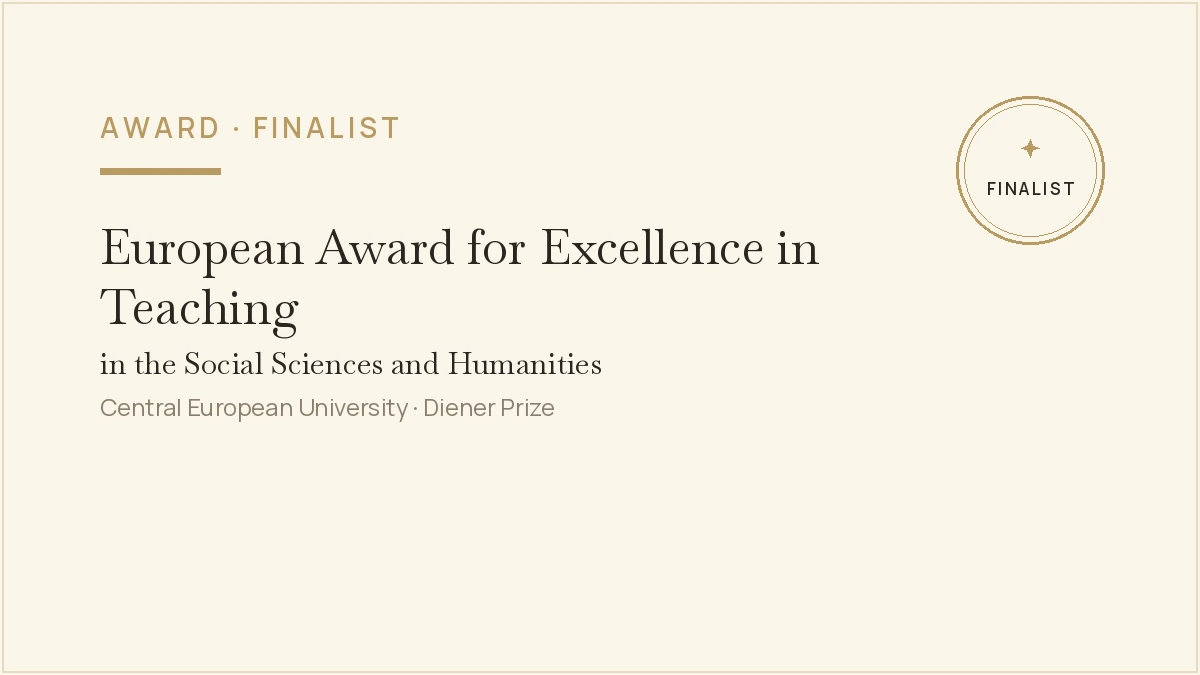
  • Teaching is described by its methods. It should be judged by its goals.

    Teaching is described by its methods. It should be judged by its goals.

    I was shortlisted for the European Award for Excellence in Teaching in the Social Sciences and Humanities. Central European University has presented it since 2011 to academics teaching in the European Higher Education Area; it carries the Diener Prize of 5,000 euros. The award went to another candidate in early September. The outcome occupies me less than something I noticed while assembling the application.

    A dossier forces you to write things down

    An application of this kind requires you to document your own teaching: course descriptions, assessment concepts, feedback from students and from colleagues, an account of your understanding of teaching. Anyone doing this inevitably reads other teaching concepts, calls for applications and accreditation documents as well. A regularity stands out: almost all of them describe first how teaching is done — blended learning, project-based work, digital tools — and only afterwards what it is meant to achieve. The second part often remains implicit.

    The difference between means and ends

    In decision analysis this distinction is central. A fundamental objective is what you pursue for its own sake. A means objective matters only because it contributes to a fundamental objective. Flipped classroom, peer feedback, AI-supported tools: all of them means. They are replaceable as soon as something better becomes available.

    The order is not merely a question of presentation. It determines which alternatives come into view at all.

    Start with methods and you vary what you already know. Start with objectives and you arrive at alternatives that do not appear in the catalogue of methods.

    That may mean different assessment formats, different assignments, and sometimes the conclusion that a piece of content has no place in the curriculum.

    The question that should come first

    What should graduates be able to do that they could not do without this degree? My answer: they should be able to structure a decision under uncertainty so that they can justify it to themselves and to others. Subject knowledge is a precondition for this, not the result. That answer implies something different from a catalogue of methods: assessments in which students document a decision of their own instead of reproducing models; projects on questions with no known solution; criteria that address the process rather than the result.

    I regard this order as the point at which teaching development is decided.

    What remains

    For me the value of such procedures lies not in their outcome but in the compulsion to be explicit. You have to write down what you otherwise take for granted, and in doing so you notice where the justification gets thin. That does not require a prize. It is enough to read one of your own course descriptions with a single question in mind: does it say what all this is good for — or only how it is done?

    About the award: European Award for Excellence in Teaching in the Social Sciences and Humanities, presented by Central European University — elkana.ceu.edu

    Further reading: MCI news item of 29 September 2025 on the shortlist nomination

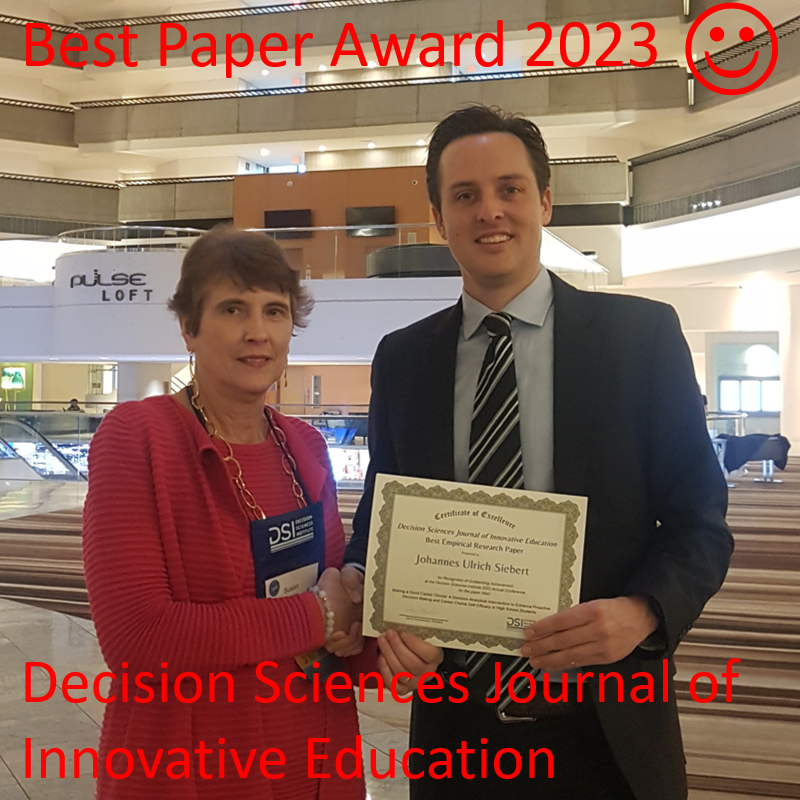
  • MCI-Prof. Johannes Siebert wins prestigious Best Paper Award

    MCI-Prof. Johannes Siebert wins prestigious Best Paper Award

    We are delighted that the article “Making a good career choice: A decision-analytical intervention to enhance proactive decision-making and career choice self-efficacy in high school students” by Prof. Johannes Siebert, Dr. Nadine Oeser, and Dr. Maxi Becker was awarded the Best Research Paper 2023 by the renowned Decision Sciences Journal of Innovative Education. In previous studies, Siebert/Kunz/Rolf (2020, 2021) demonstrated the effectiveness of decision-making skills training for students and managers. Taken together, the studies allow the conclusion that proactive cognitive decision-making skills can be improved through decision-making skills training and, as a result, participants experience greater self-efficacy and are more satisfied with their lives. Motivated by these research results, Prof. Siebert wanted to investigate the effectiveness of KLUG-decision-making competence training in analogy to these studies.
    Further details can be found here: https://www.mci.edu/en/news-filter-en/193-studyprogram-news/news-business-management-en/5453-best-paper-award-decision-sciences