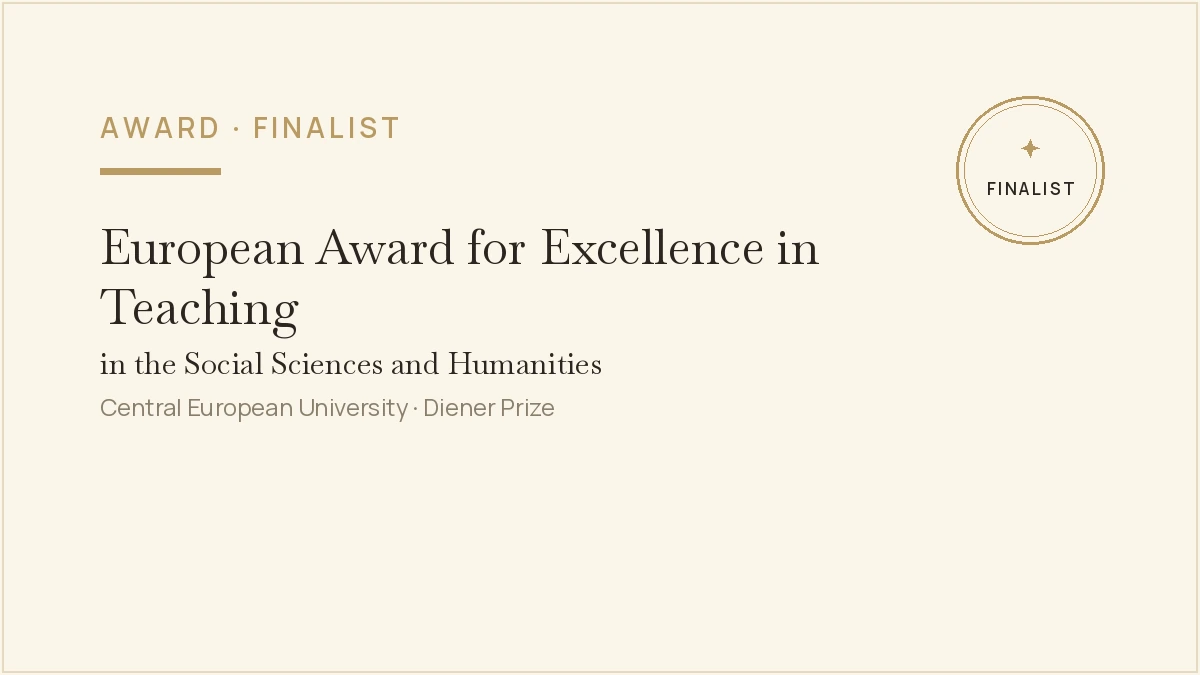
I was shortlisted for the European Award for Excellence in Teaching in the Social Sciences and Humanities. Central European University has presented it since 2011 to academics teaching in the European Higher Education Area; it carries the Diener Prize of 5,000 euros. The award went to another candidate in early September. The outcome occupies me less than something I noticed while assembling the application.
A dossier forces you to write things down
An application of this kind requires you to document your own teaching: course descriptions, assessment concepts, feedback from students and from colleagues, an account of your understanding of teaching. Anyone doing this inevitably reads other teaching concepts, calls for applications and accreditation documents as well. A regularity stands out: almost all of them describe first how teaching is done — blended learning, project-based work, digital tools — and only afterwards what it is meant to achieve. The second part often remains implicit.
The difference between means and ends
In decision analysis this distinction is central. A fundamental objective is what you pursue for its own sake. A means objective matters only because it contributes to a fundamental objective. Flipped classroom, peer feedback, AI-supported tools: all of them means. They are replaceable as soon as something better becomes available.
The order is not merely a question of presentation. It determines which alternatives come into view at all.
Start with methods and you vary what you already know. Start with objectives and you arrive at alternatives that do not appear in the catalogue of methods.
That may mean different assessment formats, different assignments, and sometimes the conclusion that a piece of content has no place in the curriculum.
The question that should come first
What should graduates be able to do that they could not do without this degree? My answer: they should be able to structure a decision under uncertainty so that they can justify it to themselves and to others. Subject knowledge is a precondition for this, not the result. That answer implies something different from a catalogue of methods: assessments in which students document a decision of their own instead of reproducing models; projects on questions with no known solution; criteria that address the process rather than the result.
I regard this order as the point at which teaching development is decided.
What remains
For me the value of such procedures lies not in their outcome but in the compulsion to be explicit. You have to write down what you otherwise take for granted, and in doing so you notice where the justification gets thin. That does not require a prize. It is enough to read one of your own course descriptions with a single question in mind: does it say what all this is good for — or only how it is done?
About the award: European Award for Excellence in Teaching in the Social Sciences and Humanities, presented by Central European University — elkana.ceu.edu
Further reading: MCI news item of 29 September 2025 on the shortlist nomination