Tag: Award

  • What remains when I am not in the room

    What remains when I am not in the room

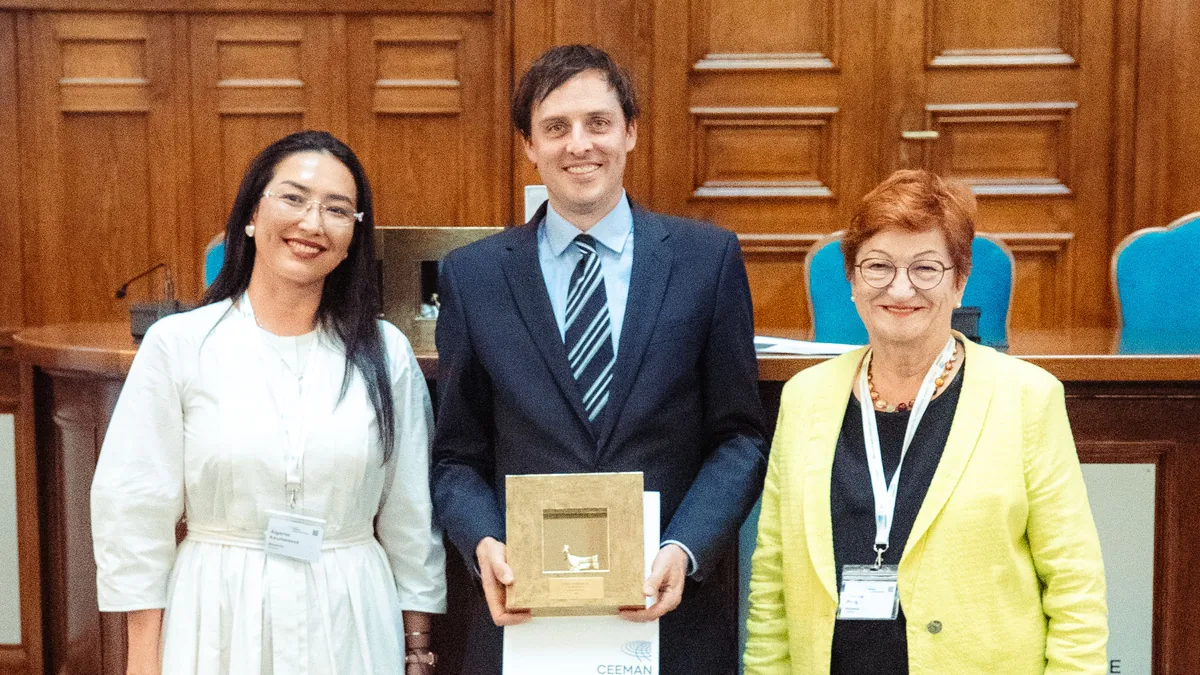
    At the 34th CEEMAN Annual Conference in Bucharest I received the CEEMAN Champion Award in the category Teacher of the Year 2026. CEEMAN is an international association for management development with around 200 member institutions from more than 50 countries; its Champion Awards recognise achievement in teaching, research, responsible management education and institutional leadership.

    What the jury highlights

    One point stands at the centre of the citation, and it is the one that matters most to me as well: my students do not analyse prepared case studies but work on a decision that actually concerns them. They clarify their objectives, develop alternatives from them, assess consequences and weigh trade-offs deliberately. This is supported by Entscheidungsnavi, which I developed together with Rüdiger von Nitzsch.

    Why the anchoring matters more to me than the course

    A course that depends on one person ends with that person. A method that only works when its originator explains it is not a method but a person. And for students who do not take the course, it has no consequences — and they are always the majority.

    That is why I am particularly glad this award does not refer to a single course. At MCI, decision-making competence is now treated across programmes as a competence in its own right and reviewed in the Assurance of Learning process. It is no longer my subject but the institution’s. Students encounter it regardless of whether they chose to.

    Where this should lead

    That is an intermediate step, not the goal. I regard decision-making competence as a future skill in the same sense as data literacy or academic writing: an ability every degree should convey, whatever the discipline.

    The argument is straightforward. Everyone makes decisions during a degree and afterwards that shape what follows — about specialisations, first jobs, moving cities, later about responsibility for others. So far we assume people can do this. Training studies show they can learn it. Between the two lies a gap that universities could close.

    What is missing is not a method — that exists. What is missing is the matter-of-factness with which we anchor other cross-cutting competences in the curriculum. That such anchoring works at one institution shows that it can be done.

    And beyond the university

    The same concepts underlie KLUGentscheiden!, an initiative to build decision-making competence among young people; more than 500 school teachers have been trained in it so far. They are also due to be used in public careers guidance, reaching several thousand advisors.

    My thanks go to CEEMAN and the jury, to my colleagues at MCI who supported the curricular anchoring — and to the students, who bring their own decisions and thereby show whether the method is worth anything.

    About the prize

    CEEMAN Champion Award – Teacher of the Year 2026, presented by CEEMAN – International Association for Management Development in Dynamic Societies, at the 34th CEEMAN Annual Conference, 24th of September 2026 in Bucharest. → https://www.ceeman.org/competitions-awards/ceeman-champion-awards/champions-2026

  • Decision-making competence can be taught – and tested

    Decision-making competence can be taught – and tested

    On 8 September I received the Ars Docendi Anerkennungspreis – the recognition award of the Austrian Federal Ministry of Women, Science and Research – in Vienna, in the category “socially and sustainability-oriented teaching”, for the course design “From subject knowledge to judgement: developing decision-making competence systematically”. I am glad about the recognition. What matters more to me is the question behind it: why do we assume so readily in higher education that students can decide – and teach it so rarely?

    What happens in the course

    Over one semester, students work on real decision problems from business, politics and society: from logistics strategies to sustainability- and technology-related challenges. They clarify their objectives, develop courses of action, compare economic, social and environmental effects, and derive a reasoned recommendation.

    The difference from a classical case study lies at the very beginning. In a case study the problem is given and the analysis is open; here it is the other way round. Students first have to work out which decision is actually at stake and which objectives are attached to it. Only then does the methodological toolkit pay off.

    Not a didactic aspiration but a testable claim

    Students should not learn to reproduce supposedly correct answers, but to make defensible decisions under uncertainty. Decision-making competence can be learned, examined and measured. This is not a programme statement: it shows up in the course evaluations.

    Embedded in the curriculum, not offered as an elective

    A course design only takes effect if it does not depend on the accident of course selection. At MCI, “Responsible Decision Making” is one of the learning goals of the bachelor programmes and is reviewed within the Assurance of Learning process of the accreditation body AACSB. The award-winning design is embedded in six bachelor programmes, so it reaches more than those who are interested anyway.

    What students take away

    “What I learned in this course I still apply today. I approach complex decisions differently than before – more structured, and with more clarity about what actually matters to me.” Julian Pfurtscheller, Chair of the MCI student union and a former student

    What the award says – and what it does not

    The Ars Docendi Anerkennungspreis honours a single course design. That is a different object from the recognitions that have come in the same period. CEEMAN, the international association for management development, presented me with the Champion Award in the category “Teacher of the Year 2026” in Bucharest on 24 September; that award refers to teaching performance as a whole. The Society of Decision Professionals recognised my engagement in advancing and applying decision analysis with the Inspirational Achievement Award, and the International Academy of Information Technology and Quantitative Management recognised my research with the Richard Price Award.

    Four awards, four different objects. What connects them is the conviction that deciding is an ability, not a character trait.

    Learning to decide does not make you more certain. It makes your choices better founded.

    About the award

    Ars Docendi – Austrian State Prize for Excellence in Teaching. Recognition award (Anerkennungspreis) in the category “socially and sustainability-oriented teaching”, presented by the Federal Ministry of Women, Science and Research in Vienna on 8 September 2026. Official Award Profile ↗   ·   Press release ↗