Category: Consulting

  • MCI Professor Johannes Siebert Receives Prestigious SDP Award

    MCI Professor Johannes Siebert Receives Prestigious SDP Award

    International recognition honors outstanding contributions to data-driven decision-making, supply chain management, and societal impact | Award presented at the 32nd SDP Annual Conference at the University of Massachusetts in Boston

    Johannes Siebert, Professor of Decision Sciences, Behavioral Economics, and Supply Chain Management at MCI, has been honored with the “Inspirational Achievement Award” by the Society ofDecision Professionals (SDP). This internationally renowned award was presented during the 32nd SDP Annual Conference at the University of Massachusetts in Boston, recognizing exceptional achievements in decision analysis and outstanding commitment to advancing the field.

    At MCI, Johannes Siebert conducts research and teaching in the field of decision analysis, with a strong focus on data-driven decision-making, behavioral economics, and multi-criteria methods. A particular emphasis lies on the role of artificial intelligence in decision processes, as well as on making decision quality measurable and trainable – key aspects in fostering innovation, digitalization, and future competencies in both academia and industry.

    “Decision science is at a turning point: artificial intelligence is transforming how decisions are made. However, at the same time, the importance of structured, value-focused decision processes has never been greater. This award strongly motivates me to further advance the field across research, practice, and teaching,” says Johannes Siebert.

    Johannes Siebert regularly contributes his expertise to international applied projects for both private and public sector partners, including initiatives in the energy, transportation, and pharmaceutical industries. His achievements have earned him multiple nominations for the Practice Award of the Decision Analysis Society. His excellence in teaching has also received international recognition, including a finalist nomination for the highly regarded European Award for Excellence in Teaching in Social Sciences and Humanities.

    MCI Rector Andreas Altmann adds: “This award highlights what MCI stands for: excellence in research, strong practical orientation, and active engagement with key societal challenges. Johannes Siebert exemplifies these values and strengthens MCI’s international reputation as a leading institution in decision sciences and management education.”

    The original press release can be found here: https://www.mci.edu/en/media-en/news/7127-mci-professor-johannes-siebert-receives-prestigious-sdp-award

  • Prioritization model for the early-stage development pipeline to enable holistic portfolio management for a pharma company

    Prioritization model for the early-stage development pipeline to enable holistic portfolio management for a pharma company

    The client was seeking a way to evaluate early development projects that would take an integrated view of the portfolio and enable consistent trade-offs. The solution was a multi-attribute prioritization methodology to enable holistic portfolio management and value-based decision making. The innovative methodology uses multi-attribute utility theory and value-focused thinking within the framework of decision quality, providing a consistent evaluation of various early-stage projects within a heterogeneous set of disease areas, thereby enabling trade-offs based on agreed-to decision criteria.

    We started the project with a brainstorming/ issue raising session and interviews with key stakeholders to define the appropriate frame, i.e., the purpose, scope, and perspective, consistent with Decision Quality. Further, we challenged the decision makers in interviews to identify their objectives. Referring to value-focused thinking, we created an objectives hierarchy as a means ends network. Using this network and the scientific expertise of client teams, we created meaningful scales to operationalize the decision makers’ fundamental objectives. We facilitated trade-off discussions with the decision makers using the www.entscheidungsnavi.de/en. We built an evaluation model based on a structure that assessed the fundamental objectives and its trade-offs using multi-attribute utility theory. Evaluating a diverse set of pilot projects with a client’s expert group, we challenged the robustness of the methodology. With the backing of the organization, we assessed the entire portfolio of projects using this new methodology. We analyzed the portfolio and identified key impacts of the decision – the level of innovation of the portfolio. We facilitated decision-focused discussions with decision makers by separating discussions about scientific expectations from discussions about strategic preferences and beliefs. Ultimately, at the end of this group decision-making process, the decision makers made a portfolio decision.

    The Strategic Decisions Group served as principal investigator in this project.

  • Identifying and structuring of the objectives of the terrorist group Islamic State

    Identifying and structuring of the objectives of the terrorist group Islamic State

    Veröffentlichung

    • Siebert, Johannes; von Winterfeldt, Detlof; John, Richard. “Identifying and Structuring the Objectives of the “Islamic State of Iraq and the Levant” (ISIL) and its Followers.” Decision Analysis (INFORMS), 13(1), 26-50. (Link)
    • Nagata, M., Abbas, A., Atran, S., Braniff, B., Bringuel, A., al-Chalabi, M., …. & Corman, S. (2014). Multi-‐Method Assessment of ISIL. (Link)
    • https://www.informs.org/Blogs/DECA-Blogs/DECA-Review/Identifying-and-Structuring-the-Objectives-of-the-Islamic-State-of-Iraq-and-the-Levant-ISIL-and-its-Followers (Link)
    • „Wer dem IS folgt, ist ein Loser“, in Welt am Sonntag, No. 4, 24th of January, 2016. (Link)
    • „Was macht den IS für Anhänger attraktiv?“, N24.de, 25th of January, 2016, (Link)

    In summer 2014, the terrorist group Islamic State was one of the most severe threats for the civilian population in the Middle East as well as in the West. The American government did not had a clear strategy how to deal with this new threat. Pres. Obama even admitted this in public (“We don’t yet have a complete strategy” for fighting the Islamic State in Iraq; 28. August 2014, in Washington Post).

    One of the main problems of the military leadership in the US was that the means, which were successful to protect the civilians against a terrorist group Al Qaeda, did not had the same impact to protect civilians against the terrorist group Islamic State. In the retrospective view, the main reason was that both terrorist groups pursue fundamentally different strategies. In order to pursue meaningful and effective measures to protect civilians it was necessary to identify the objectives of the terrorist group Islamic state. If you know what your opponent wants, it is much easier for you to prevent it.

    General Nagata, Head of Special Operations Command Central (SOCCENT) sent at the end of August 2014 an urgent request to the Center for Risk and Economic Analysis of Terrorism Events (CREATE) at University of Southern California to find out, what the terrorist group Islamic State wants, i.e., the objectives the leaders of the followers, and why they are so attractive to their followers. This task is particularly difficult, because there is no access to the leaders and members of the terrorist group Islamic state for interviewing them. Therefore, the Office of the Joint Chief of Staff in the Pentagon reached out to 59 subject matter experts with backgrounds in terrorism research, Islam, political science, military strategy, the Middle East, peace research, etc. and conducted semi-structured interviews. Prof. von Winterfeldt, one of the worldwide leading counterterrorism researchers and founding director of CREATE, analyzed these interviews to identify and structure the objectives of the leadership and the followers of Islamic State. Prof. Siebert took the lead in the second, separate effort solely based on open sources available on the Internet, for example primary sources such as transcribed speeches of Islamic State leaders or secondary sources such as newspaper articles or scientific papers. In the next step, both separately and independently derived objectives hierarchies were compared and merged. There was a great deal of overlap and similarity.  However, the researchers also found some notable differences, especially regarding the followers’ objectives, which could be explained primarily by the different sources used.

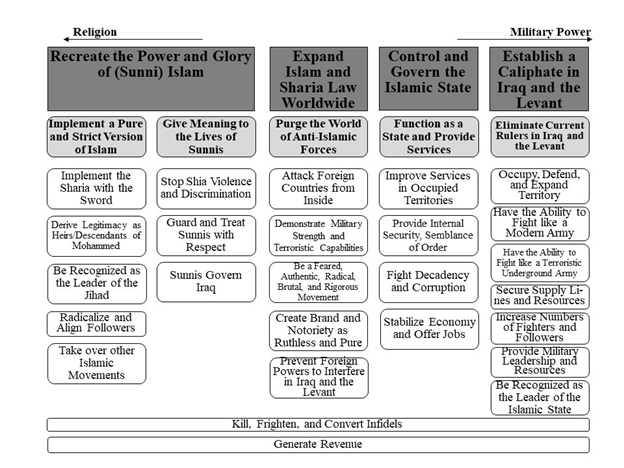
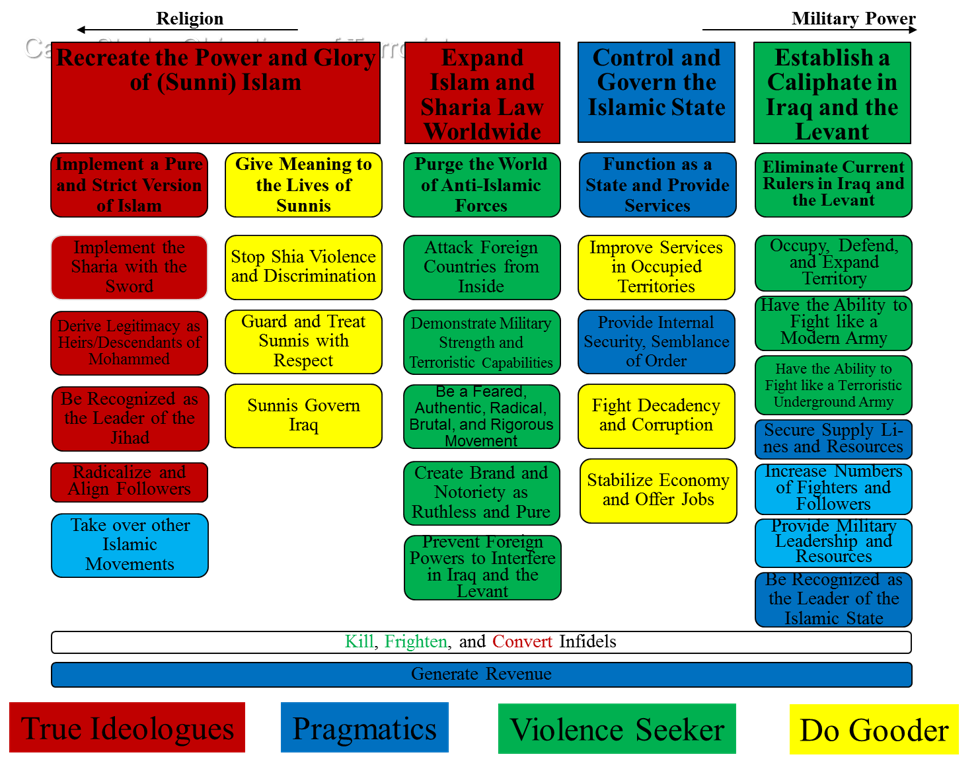
    The results indicate that Islamic State’s leaders pursue four strategic objectives “Establish a Caliphate in Iraq and the Levant”, “Control and Govern the Caliphate”, “Expand Islam and Sharia Law Worldwide”, and “Recreate the Power and Glory of (Sunni) Islam”. The followers’ objectives can be partitioned into three strategic objectives: Humanitarian Fulfillment, Religious Fulfillment and Personal Fulfillment. The objectives identified from the subject matter expert interviews were similar to those identified from Islamic State leaders’ statements and the Internet. However, the Internet search revealed many more personal objectives of Islamic State followers. The results further indicate that Islamic State`s leadership objectives are closely aligned with those of its followers. There also is a sharp contrast between the objectives of Islamic State and those of Al Qaeda, particularly Islamic State’s emphasis on occupying and controlling territories on Iraq and Syria vs. Al Qaeda’s focus on worldwide jihad. The objectives hierarchy of the leaders of Islamic state is illustrated in the following figure.

    This study resulted in a successful publication in the INFORMS journal Decision Analysis. In addition, the editor of Decision Analysis, found that the importance of the study warranted the creation of a media campaign through special announcements and a blog, the first time that this journal has made such an effort. Perhaps more importantly, the work made an impact on a major policy area by providing a report to General Nagata and the US Special Operations Unit in the Middle East. The study was nominated for the final of the Practice Award of the INFORMS Decision Analysis Society because of the high level of novelty of the methods to systematically identify and structure objectives of an organization when there is no access to the decision-maker and the high impact on the real world. A detailed description of the method and results, the project report and selected media coverage can be found in the following

  • Developing the decision support system “Entscheidungsnavi”

    Developing the decision support system “Entscheidungsnavi”

    Veröffentlichung

    von Nitzsch Rüdiger, Tönsfeuerborn Mendy., Siebert Johannes U. (2020) Decision Skill Training with the Entscheidungsnavi. In: de Almeida A.T., Morais D.C. (eds) Innovation for Systems Information and Decision. INSID 2020. Lecture Notes in Business Information Processing, vol 405. Springer, Cham. https://doi.org/10.1007/978-3-030-64399-7_2

    Siebert, Johannes; Rüdiger von Nitzsch. “Das Jobauswahlproblem für Berufseinsteiger: Eine entscheidungstheoretische Anwendung – Teil 1: Problemstrukturierung in Ziele, Alternativen und Unsicherheiten“, Wissenschaftliche Beiträge, Wirtschaftswissenschaftliches Studium, October 2018

    Rüdiger von Nitzsch; Siebert, Johannes. „Das Jobauswahlproblem für Berufseinsteiger: Eine entscheidungstheoretische Anwendung – Teil 2: Ermittlung der besten Alternative mit dem ENTSCHEIDUNGSNAVI“, Wissenschaftliche Beiträge, Wirtschaftswissenschaftliches Studium, November 2018

    Rüdiger von Nitzsch; Siebert, Johannes. „Systematische Entscheidungshilfe durch das ENTSCHEIDUNGSNAVI: Hintergründe und Erläuterungen“

    My objective improving individual and organizational decision-making. Therefore, my colleague von Nitzsch (RWTH Aachen) and I develop a web-based decision support system for decisions with multiple objectives (www.entscheidungsnavi.de, more information the project: www.proaktiv-entscheiden.de). The special about the entscheidungsnavi is sophisticated support which allows decision-makers to structure their decision problem appropriately. Furthermore, the latest research results on decision-making biases and behavior, in general, are considered to ensure high-quality results

  • »EMPOWER«:  A Decision Support System to Increase Efficiency of Logistic Processes in Upper Franconian SMEs

    »EMPOWER«:  A Decision Support System to Increase Efficiency of Logistic Processes in Upper Franconian SMEs

    Due to the changing framework conditions and customer requirements, such as shorter delivery times and increasing adherence to delivery dates, small and medium-sized enterprises (SMEs) in Upper Franconia are increasingly confronted with an increase in logistics performance and a reduction in logistics costs. Logistics, especially production logistics, is an essential basis for these companies to generate competitive and cost advantages and is becoming increasingly important.

    In this context, however, many SMEs are asking themselves how the potential for generating competitive and cost advantages in production logistics can be identified, evaluated, and leveraged. Generally, it is possible to raise the identified potential by deriving concrete optimization measures. However, deriving these measures is difficult in many cases, and there is a deficit regarding a methodically structured and systematic decision-making process.

    The decision-making process in SMEs is often characterized by a system break between the analysis and decision-making phases. The result is that the recording and evaluation of the actual situation is insufficient or not taken into account in the decision-making phase, and the decision-making is neither based on the analysis phase nor based on an adequate definition of goals. The results here are implemented optimization measures (e.g., measures from the area of lean management) that make no or only a limited contribution to the achievement of the defined goals and may lead to deterioration at another point in the overall production-logistic system.

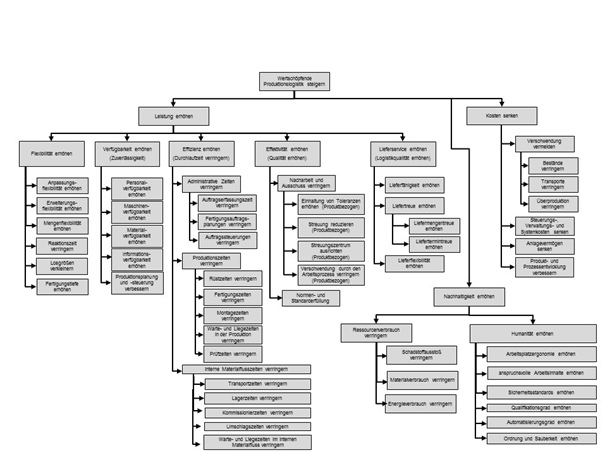
    The “empower” project aims to develop an interdisciplinary concept for methodical decision support when selecting alternative measures to increase the efficiency of production logistics processes in Upper Franconian SMEs. The concept is the basis for developing a software application that holistically supports the decision-making process. (© and further information: https://empower.fh-rosenheim.de/). An overview of relevant goals in production logistics can be found below.

  • Designing a Media-Specific Balanced Scorecard by Applying Value-Focused Thinking

    Designing a Media-Specific Balanced Scorecard by Applying Value-Focused Thinking

    Publications

    Siebert, Johannes U.; Kunz, Reinhard „Entwicklung einer Balanced Scorecard mit Value-focused Thinking am Beispiel eines mittelgroßen Medienunternehmens“. Controlling: Zeitschrift für erfolgsorientierte Unternehmenssteuerung, March 2016, 210-215. DOI:  10.15358/0935-0381-2016-3-209

    Kunz, Reinhard; Siebert, Johannes; Mütterlein. “Combining Value-Focused Thinking and Balanced Scorecard to Improve Decision-Making in Strategic Management”, Journal of Multi-Criteria Decision Analysis, September-December, 2016, 225-241 DOI: 10.1002/mcda.1572

    Kunz, Reinhard; Siebert, Johannes; Mütterlein, Joschka. „A Media-Specific Balanced Scorecard Based on Value-Focused Thinking“, Journal of Media Business Studies, 13(4), 2016, 257-275. http://www.tandfonline.com/doi/full/10.1080/16522354.2016.1220114

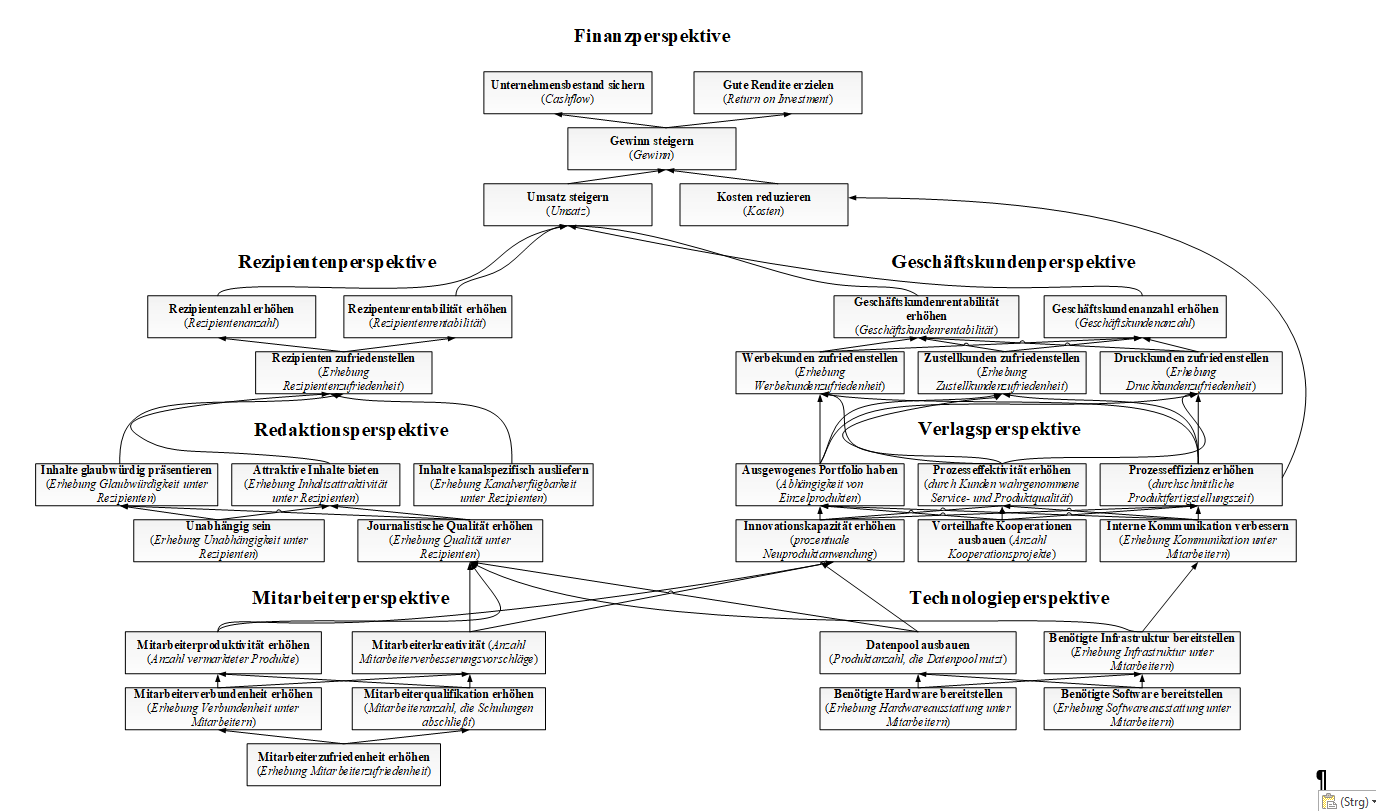
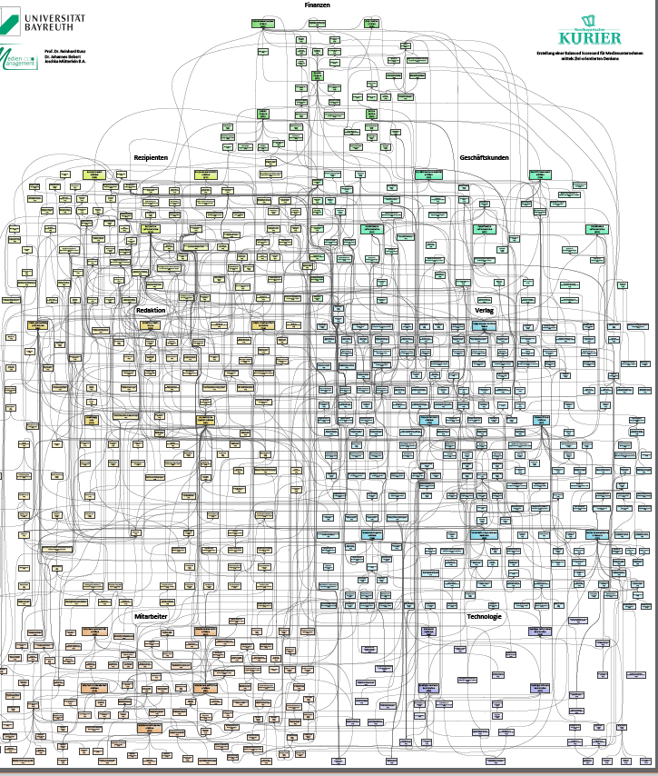
    The Balanced Scorecard (Kaplan and Norton 1992) is one of the five management tools used most often and has been implemented by nearly 40 percent of the companies (Rigby and Bilodeau 2013). Yet, there is no theoretically sound approach for developing a balanced scorecard. Value-focused thinking is a decision-making philosophy that fits perfectly to Balanced Scorecard creation. It provides methods and techniques for the identification and structuring of objectives that are suitable to systematically derive a scorecard from a means-ends network. However, such a means-ends network is often too complex for enduring use in strategic management. By adapting the network’s structure to the Balanced Scorecard’s layout, the profound and clear set of derived objectives and their measures provide a reasonable basis for applying methods of multi-criteria decision-making in an organization. In a case study, we develop a media-specific Balanced Scorecard to provide media decision-makers with a model that takes characteristics of media management into account and that helps to manage their company successfully. Using a scientifically sound approach that is based on value-focused thinking (Keeney, 1992), we interview the publisher, the CEO, nine management representatives, and ten key employees of a German medium-sized local newspaper company. Overall, 698 distinct objectives and 1,009 relationships are identified. By concentrating on the most important objectives, we derive a Balanced Scorecard with 33 objectives and 65 relationships, which are organized in seven perspectives. Because of its innovativeness, this project was runner-up in the final of the Practice Awards der Decision Analysis Society (INFORMS).

  • Caltrans: Which road projects deserve the money?

    Caltrans: Which road projects deserve the money?

    Through the State Highway Operation and Protection Program (SHOPP), the California Department of Transportation (Caltrans) was investing around USD 2.3 billion a year at the time in maintaining, rehabilitating and improving the safety of state highways and bridges. In September 2014, Ralph Keeney and I advised Caltrans on how to prioritise these projects more transparently.

    Client: California Department of Transportation (Caltrans), SHOPP Pilot Project
    Period: September 2014
    Role: Advisory work in the framing phase, together with Ralph Keeney
    Output: Recommendations report “Recommendations about Decision-Making for Caltrans SHOPP Project Prioritization” (Keeney & Siebert)
    Method: Value-Focused Thinking, Multi-Objective Decision Analysis

    The starting point

    Until then, SHOPP projects were prioritised through 31 programmes. Whether a project received funding depended mainly on which programme it was assigned to and how highly that programme ranked. What a project actually achieves – across several assets and relative to its cost – could hardly be captured this way. Caltrans had just adopted a new vision, mission and set of goals and had compiled an extensive list of possible evaluation criteria. The question was: how do you turn this into a prioritisation that is logically sound and can be justified to policymakers and the public?

    What we did

    On 22 September 2014, Ralph Keeney and I held a series of meetings in Sacramento over the course of one day: with the core project team, with the heads of finance, project delivery, maintenance and planning, with two district directors and with a representative of the California Transportation Commission. We wanted to understand how SHOPP decisions were being made and what leadership hoped for from a better process. We then summarised our recommendations in a report. Three of them I still consider central.

    Fundamental objectives instead of criteria lists

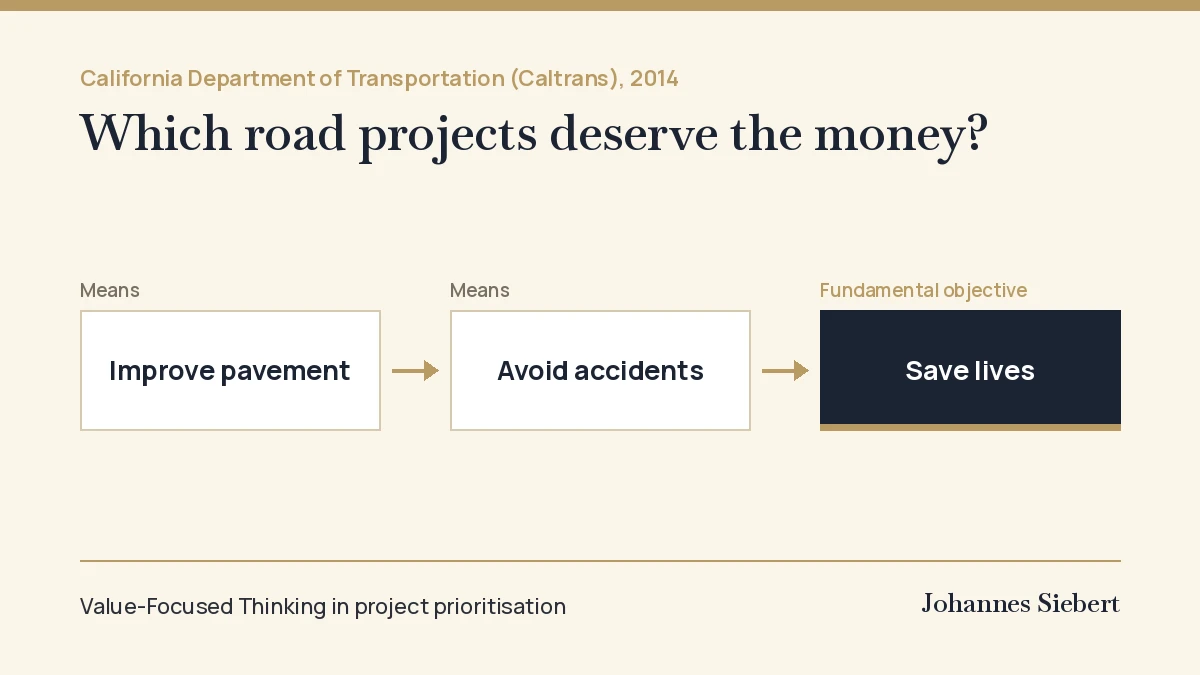
    Most of the criteria collected were means to an end rather than actual objectives. An example:

    Improve pavement → avoid accidents → save lives

    Only the last link is a fundamental objective – something we care about for its own sake. Evaluating means objectives and fundamental objectives together counts the same benefit twice. We did not have to invent the fundamental objectives from scratch: they could be derived directly from Caltrans’ new goals – maximise safety, minimise costs, minimise disruption of the economy and minimise inconvenience. Two further Caltrans goals, system performance and organisational excellence, depend more on the agency’s actions as a whole than on the selection of individual projects and therefore do not belong in the project evaluation.

    Making objectives measurable

    Each fundamental objective needs an attribute that measures how well an alternative achieves it. Sometimes there is a natural measure, such as cost in dollars. Sometimes a proxy measure has to do, such as accidents avoided instead of fatalities avoided. And sometimes it is worth constructing a dedicated measure that, for example, weights head-on collisions more heavily than minor accidents.

    Weights from trade-offs, not from ‘importance’

    The question ‘Which is more important, accidents or costs?’ has no meaningful answer. Is one avoided accident more important than a billion dollars? Hardly. More important than a thousand dollars? Probably. The only meaningful question is how much a specific change in one objective is worth compared with a specific change in another. If, for instance, one avoided accident is valued at two million dollars, a project that costs 120 million dollars and avoids 100 accidents creates a net value equivalent to 80 million dollars. Value judgements of this kind can be made explicit, discussed and checked against the organisation’s mission.

    What I took away

    The greatest leverage lay not in the calculation but in the question that comes before it: what does the organisation actually want to achieve with its projects? Once the fundamental objectives are clear, data requirements, weighting and communication become much easier. Good prioritisation starts with objectives, not with data.

    Postscript (September 2026): Building on our recommendations and further advice from Lee Merkhofer, the Caltrans team developed a prioritisation model based on Multi-Objective Decision Analysis, including a prototype, by June 2015. The Caltrans goals from which we derived the fundamental objectives in 2014 remained the agency’s official goals until 2020. Since then, Caltrans has reformulated them in two strategic plans; safety remains at the top, and economic prosperity is now a goal in its own right. Caltrans has published the final report of the pilot project, with our recommendations report in the appendix: SHOPP Pilot Project – Phase 1: A Framework for Project Prioritization (PDF, appendix).

  • Identifying and structuring strategic objectives: a case study of a major energy utility

    Identifying and structuring strategic objectives: a case study of a major energy utility

    Identifying and structuring strategic objectives: a case study of a major energy utility

    Before a company can develop good strategic alternatives, it has to be clear about what it actually wants to achieve. After Germany’s nuclear phase-out, Ralph Keeney and I worked this out for a major European energy utility: all of the company’s strategic objectives, condensed onto a single page.

    Client: major European energy utility (anonymised)
    Period: from early 2013
    Method: Value-Focused Thinking
    Participants: all members of the executive board, the chair of the supervisory board, around a dozen managers in key positions
    Outcome: objectives network with three main areas, developed from around 450 identified objectives

    Background

    After the Fukushima nuclear disaster in March 2011, German energy policy underwent a paradigm shift: the government led by Angela Merkel decided at short notice to phase out nuclear power. The major utilities operating nuclear plants were caught unprepared, and the economic consequences were substantial. The company we worked with estimated its long-term profit losses at around EUR 1 billion per year.

    The pressure to develop high-quality strategic alternatives was correspondingly high. But that first requires the company’s strategic objectives to be identified and structured systematically.

    Approach

    I took on this task in early 2013 together with Ralph Keeney, professor emeritus at Duke University and originator of Value-Focused Thinking. We conducted individual interviews with every member of the executive board, the chair of the supervisory board and around a dozen managers in key positions, who together covered all relevant business units. We also systematically analysed publicly available documents and internal planning documents for potential objectives.

    This produced an initial set of around 450 objectives. We categorised them, eliminated redundancies, organised the remaining objectives into a network and visualised it in a single clear diagram.

    Outcome: an objectives network with three areas

    Laying the foundations for future success. This area contains objectives on good leadership, on building and developing a highly qualified workforce, and on consistently making good decisions.

    Running the business smartly and with an eye on the future. Here it became clear that two different objective systems coexisted within the company. In the traditional, regulated business, “increase efficiency” and “minimise costs” were central. In the new, unregulated fields such as renewable energy, the focus was on “develop new products”, “enter new markets” and “win new customers”.

    Not just surviving but thriving in an uncertain market. The core question is what value the company aims to create for its stakeholders: for customers, a secure and reliable energy supply at reasonable prices; for shareholders, an appropriate and stable dividend; for the region, strong local engagement; and for employees, secure jobs on fair terms that they enjoy doing.

    The key insight

    The company was operating in two business areas with fundamentally different objectives. In the regulated area, “operate effectively and efficiently” was central; in the unregulated area, “create and market new products and processes”. Behind these lie different management philosophies. Among other things, this explained why employees who had spent many years in the traditional business often struggled in the new one.

    When we presented the results to the executive board, the CEO, then 100 days in office, said he was impressed that everything that mattered to the company could be condensed onto one page. The clear distinction between the regulated and unregulated areas, he said, had been the missing piece he needed to communicate his vision for the company clearly to his staff.

    What carries over

    This approach suits organisations facing a strategic reorientation: when their environment changes fundamentally, new leadership takes over, or established and new businesses have to work under one roof. An explicit objectives network makes visible what really matters, uncovers conflicting objective systems and lays the groundwork for developing and evaluating better alternatives.

    Originally published in April 2015, updated in September 2026.