Tag: decision competence

  • Decision-making competence can be taught – and tested

    Decision-making competence can be taught – and tested

    On 8 September I received the Ars Docendi Anerkennungspreis – the recognition award of the Austrian Federal Ministry of Women, Science and Research – in Vienna, in the category “socially and sustainability-oriented teaching”, for the course design “From subject knowledge to judgement: developing decision-making competence systematically”. I am glad about the recognition. What matters more to me is the question behind it: why do we assume so readily in higher education that students can decide – and teach it so rarely?

    What happens in the course

    Over one semester, students work on real decision problems from business, politics and society: from logistics strategies to sustainability- and technology-related challenges. They clarify their objectives, develop courses of action, compare economic, social and environmental effects, and derive a reasoned recommendation.

    The difference from a classical case study lies at the very beginning. In a case study the problem is given and the analysis is open; here it is the other way round. Students first have to work out which decision is actually at stake and which objectives are attached to it. Only then does the methodological toolkit pay off.

    Not a didactic aspiration but a testable claim

    Students should not learn to reproduce supposedly correct answers, but to make defensible decisions under uncertainty. Decision-making competence can be learned, examined and measured. This is not a programme statement: it shows up in the course evaluations.

    Embedded in the curriculum, not offered as an elective

    A course design only takes effect if it does not depend on the accident of course selection. At MCI, “Responsible Decision Making” is one of the learning goals of the bachelor programmes and is reviewed within the Assurance of Learning process of the accreditation body AACSB. The award-winning design is embedded in six bachelor programmes, so it reaches more than those who are interested anyway.

    What students take away

    “What I learned in this course I still apply today. I approach complex decisions differently than before – more structured, and with more clarity about what actually matters to me.” Julian Pfurtscheller, Chair of the MCI student union and a former student

    What the award says – and what it does not

    The Ars Docendi Anerkennungspreis honours a single course design. That is a different object from the recognitions that have come in the same period. CEEMAN, the international association for management development, presented me with the Champion Award in the category “Teacher of the Year 2026” in Bucharest on 24 September; that award refers to teaching performance as a whole. The Society of Decision Professionals recognised my engagement in advancing and applying decision analysis with the Inspirational Achievement Award, and the International Academy of Information Technology and Quantitative Management recognised my research with the Richard Price Award.

    Four awards, four different objects. What connects them is the conviction that deciding is an ability, not a character trait.

    Learning to decide does not make you more certain. It makes your choices better founded.

    About the award

    Ars Docendi – Austrian State Prize for Excellence in Teaching. Recognition award (Anerkennungspreis) in the category “socially and sustainability-oriented teaching”, presented by the Federal Ministry of Women, Science and Research in Vienna on 8 September 2026. Official Award Profile ↗   ·   Press release ↗  
  • Sound decisions are the key

    Sound decisions are the key

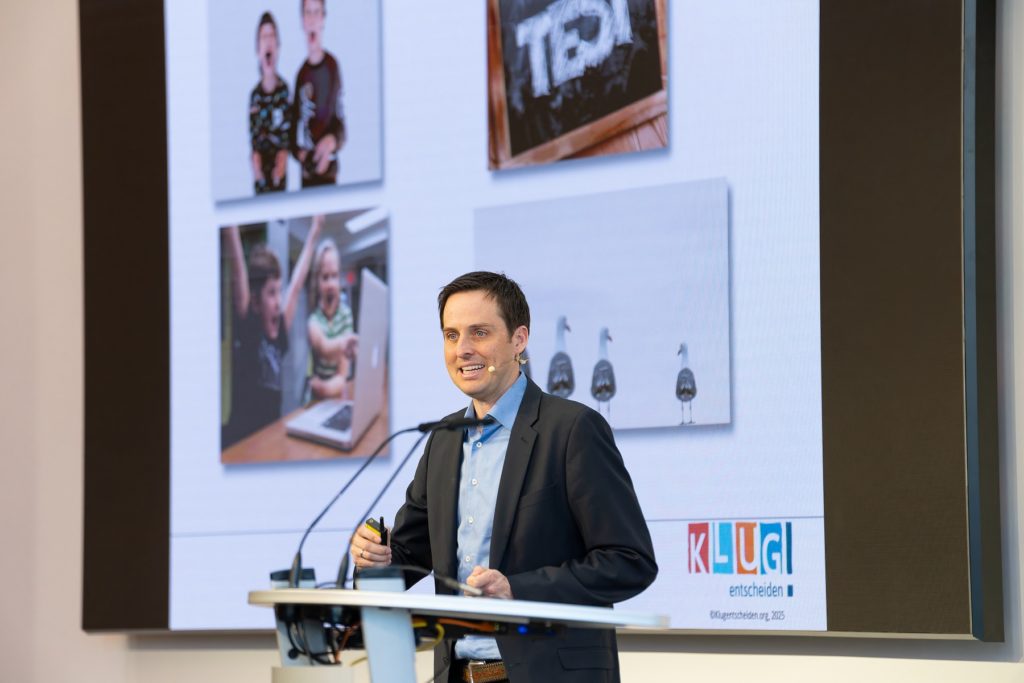
    At the second Education Summit of the Employers’ Associations of Lower Saxony I spoke about the question career orientation usually skips: young people learn a great deal about which paths exist – and almost nothing about how to choose between them.

    Talk: Sound decisions are the key – Career orientation through decision analysis
    Event: 2nd UVN Education Summit, “Career orientation as the key to success”
    Date and venue: 19 March 2025, Karriere-Campus Hannover
    Host: Unternehmerverbände Niedersachsen e.V. (UVN)
    Event page (UVN)  ·  Recording of the summit

    Around 250 guests from business, schools and politics came together at the Karriere-Campus in Hannover. The political line-up showed how much weight the topic carries in Lower Saxony: two state ministers took part – Minister of Education Julia Willie Hamburg and Minister of Economic Affairs Olaf Lies, now Minister-President of the state.

    Postponing is a decision too

    Roughly one in three young people drops out of vocational training or university study shortly after starting – with consequences for the skills shortage and a considerable burden on the individuals themselves. One reason is rarely named: many young people see decisions as problems to be solved. Solving problems is unpleasant, so they put it off. At some point the window closes and only the leftovers remain. Or they do “nothing for now” – and the first “nothing for now” is usually followed by a second.

    We need to inspire young people not only about careers, but about choosing one.

    Decision competence is the missing building block

    Internships, aptitude tools, careers fairs, open days: the existing offerings achieve a great deal, and they have one thing in common – they widen the range of choices. What they cannot do is make the choice. That requires the ability to decide independently and on a sound basis. Decision competence therefore does not compete with established career orientation; it is the building block that makes it effective.

    I illustrated this with KLUGentscheiden, which I initiated as a research project at the University of Bayreuth. Using methods from decision analysis, we break a student’s decision down into manageable steps together with them: clarify objectives, develop alternatives, bring the two together. Our digital tool KLUGnavi supports the analysis. The evaluation shows that afterwards students perceive the choice of career or study programme as less difficult and rate themselves as more proactive and more self-efficacious (Siebert, Becker & Oeser, 2023, Decision Sciences Journal of Innovative Education 21(1), 10–25).

    The bottleneck is anchoring it in schools

    Teachers’ interest is considerable – in Bavaria alone we have trained more than 400 of them as multipliers, and the materials are available free of charge. The real hurdle comes afterwards: it is precisely the most committed teachers who meet resistance when they try to establish the programme permanently at their school.

    Saarland shows how it can work. There, “KLUGentscheiden! goes Saar” – funded by the statutory health insurance funds and run together with the Landesamt für Pädagogik und Medien and the Ministry of Education and Culture – is working on exactly that until 2027: adapting the materials to different timetable formats, qualifying teachers through train-the-trainer sessions, and handing delivery over to the schools themselves. That kind of structural anchoring is what is needed – and it is what I spoke about in Hannover.

    More on materials and teacher training: klugentscheiden.org

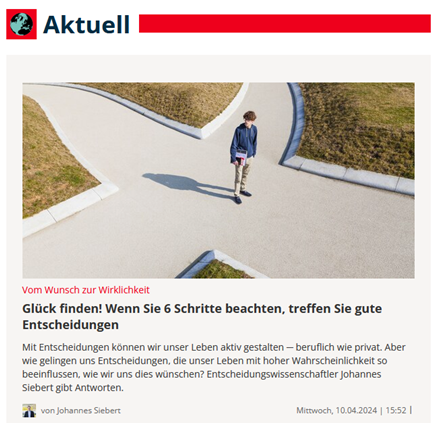
  • From wish to reality: Find happiness! If you follow 6 steps, you will make good decisions

    From wish to reality: Find happiness! If you follow 6 steps, you will make good decisions

    We can actively shape our lives through our decisions ─ both professionally and personally. But how do we make decisions that are likely to influence our lives in the way we want them to? Decision scientist Johannes Siebert provides answers.

    We often invest a lot of time and energy in important decisions. Nevertheless, sometimes we are dissatisfied with ourselves afterward. But when is self-criticism justified? What makes a good decision anyway?

    Only when we are clear about how we can make good decisions can we increase our own life satisfaction through our actions.

    First of all, a key point: the results of our decisions are not a criterion for their quality. Although we can influence the future, it is never entirely up to us how it turns out. There is always a residual uncertainty.

    Imagine we decide to travel to a destination known for its white sandy beaches and reliably sunny weather in the summer months. Then, we experience heavy rain showers, cold winds, or tanker accidents that pollute the beach.

    Did we make a wrong decision because of this? No, because we could neither foresee nor influence any of this when we made our decision.

    Instead, the quality of our decisions depends on six elements that are primarily within our own control and that interlock like the links in a chain. The following applies: the decision can never be better than the weakest link in the chain. It is, therefore, worth striving for the highest possible quality in all of the following six elements!

    Read the full article here (in German): https://www.focus.de/experts/vom-wunsch-zur-wirklichkeit-yes-we-can-mit-diesen-6-schritten-finden-sie-ihr-persoenliches-glueck_id_259842310.html

    Please stay current and not miss any of my contributions on FOCUS Online. For exciting insights and current discussions, follow me and network with me. I look forward to exchanging ideas with you! https://www.linkedin.com/in/johannes-siebert/