Tag: decision analysis

  • Deciding for a Secure Tomorrow: Proactive Decision-Making and Retirement Financial Planning Behavior

    Deciding for a Secure Tomorrow: Proactive Decision-Making and Retirement Financial Planning Behavior

    Retirement financial planning behavior (RFPB) encompasses the concrete actions individuals take to prepare financially for retirement. We examine RFPB from an Operational Research (OR) perspective using Decision Analysis (DA) principles—decision quality and value-focused thinking—operationalized via proactive decision-making (PDM), which integrates DA-grounded proactive cognitive skills (PCS) with proactive personality traits derived from the organizational behavior literature. Using cross-sectional survey data from 457 UK adults and structural equation modelling with systematic model comparisons and multigroup tests, we assess whether PDM influences RFPB through four psychological traits—propensity to plan, confidence in financial information search, willingness to accept investment risk, and general self-efficacy—and whether relationships differ by financial literacy and numeracy. Results show that PDM affects RFPB entirely through these psychological traits (full mediation), with PCS—the trainable, DA-grounded decision-analytic skills—serving as the operative mechanism, while proactive personality traits are non-significant in this pathway. The mediated model explains 57.1% of RFPB variance and outperforms partial-mediation, traits-only, and reverse-causality alternatives. Multigroup analyses indicate that the indirect structure holds across financial literacy and numeracy groups, with patterns suggesting a compensatory role of PCS under lower financial literacy. Together, the evidence links DA-grounded decision-analytic skills to RFPB. Our findings highlight the potential of PCS-focused decision-analytic competence training as an OR-relevant mechanism to promote RFPB, complementing financial literacy and numeracy programs. Additionally, our study complements optimization-focused OR approaches to retirement financial planning by identifying PCS as a decision-analytic lever that strengthens RFPB—the behavioural precondition for adopting such optimized prescriptions in practice.

    Siebert, Jana; Siebert, Johannes U.; Blösl, Florian. “Deciding for a secure tomorrow: Proactive decision-making and retirement financial planning behavior.” European Journal of Operational Research, 331(3), 2026, 878–893. https://doi.org/10.1016/j.ejor.2025.10.021

  • MCI Professor Johannes Siebert Receives Prestigious SDP Award

    MCI Professor Johannes Siebert Receives Prestigious SDP Award

    International recognition honors outstanding contributions to data-driven decision-making, supply chain management, and societal impact | Award presented at the 32nd SDP Annual Conference at the University of Massachusetts in Boston

    Johannes Siebert, Professor of Decision Sciences, Behavioral Economics, and Supply Chain Management at MCI, has been honored with the “Inspirational Achievement Award” by the Society ofDecision Professionals (SDP). This internationally renowned award was presented during the 32nd SDP Annual Conference at the University of Massachusetts in Boston, recognizing exceptional achievements in decision analysis and outstanding commitment to advancing the field.

    At MCI, Johannes Siebert conducts research and teaching in the field of decision analysis, with a strong focus on data-driven decision-making, behavioral economics, and multi-criteria methods. A particular emphasis lies on the role of artificial intelligence in decision processes, as well as on making decision quality measurable and trainable – key aspects in fostering innovation, digitalization, and future competencies in both academia and industry.

    “Decision science is at a turning point: artificial intelligence is transforming how decisions are made. However, at the same time, the importance of structured, value-focused decision processes has never been greater. This award strongly motivates me to further advance the field across research, practice, and teaching,” says Johannes Siebert.

    Johannes Siebert regularly contributes his expertise to international applied projects for both private and public sector partners, including initiatives in the energy, transportation, and pharmaceutical industries. His achievements have earned him multiple nominations for the Practice Award of the Decision Analysis Society. His excellence in teaching has also received international recognition, including a finalist nomination for the highly regarded European Award for Excellence in Teaching in Social Sciences and Humanities.

    MCI Rector Andreas Altmann adds: “This award highlights what MCI stands for: excellence in research, strong practical orientation, and active engagement with key societal challenges. Johannes Siebert exemplifies these values and strengthens MCI’s international reputation as a leading institution in decision sciences and management education.”

    The original press release can be found here: https://www.mci.edu/en/media-en/news/7127-mci-professor-johannes-siebert-receives-prestigious-sdp-award

  • Fifty years of decision analysis in operational research: A review

    Fifty years of decision analysis in operational research: A review

    We review the development of research in Decision Analysis (DA) over the past fifty years. After presenting the axiomatic foundations and discussing the DA process, we start with value-focused thinking as a problem structuring method. We then analyze the model building phase, with a focus on graphical models for decision-making under uncertainty: belief networks, decision trees, and influence diagrams. Next, we analyze how DA research has dealt with uncertainty focusing on the areas of elicitation, aggregation, and evaluation. We then discuss sensitivity analysis, describing local and global techniques, from one-way sensitivity analysis to the value of information. Finally, we review the literature on information acquisition and discuss the role of information value in this context

    Borgonovo, Emanuele; Jose, Victor Richmond R.; Knowlton, Morgan; Shachter, Ross; Siebert, Johannes U.; Ulu, Canan. “Fifty years of decision analysis in operational research: A review.” European Journal of Operational Research, 329(2), 2026, 355–377. https://doi.org/10.1016/j.ejor.2025.05.023

    Invited review on the occasion of the 50th anniversary of EURO (Association of European Operational Research Societies).

  • Sound decisions are the key

    Sound decisions are the key

    At the second Education Summit of the Employers’ Associations of Lower Saxony I spoke about the question career orientation usually skips: young people learn a great deal about which paths exist – and almost nothing about how to choose between them.

    Talk: Sound decisions are the key – Career orientation through decision analysis
    Event: 2nd UVN Education Summit, “Career orientation as the key to success”
    Date and venue: 19 March 2025, Karriere-Campus Hannover
    Host: Unternehmerverbände Niedersachsen e.V. (UVN)
    Event page (UVN)  ·  Recording of the summit

    Around 250 guests from business, schools and politics came together at the Karriere-Campus in Hannover. The political line-up showed how much weight the topic carries in Lower Saxony: two state ministers took part – Minister of Education Julia Willie Hamburg and Minister of Economic Affairs Olaf Lies, now Minister-President of the state.

    Postponing is a decision too

    Roughly one in three young people drops out of vocational training or university study shortly after starting – with consequences for the skills shortage and a considerable burden on the individuals themselves. One reason is rarely named: many young people see decisions as problems to be solved. Solving problems is unpleasant, so they put it off. At some point the window closes and only the leftovers remain. Or they do “nothing for now” – and the first “nothing for now” is usually followed by a second.

    We need to inspire young people not only about careers, but about choosing one.

    Decision competence is the missing building block

    Internships, aptitude tools, careers fairs, open days: the existing offerings achieve a great deal, and they have one thing in common – they widen the range of choices. What they cannot do is make the choice. That requires the ability to decide independently and on a sound basis. Decision competence therefore does not compete with established career orientation; it is the building block that makes it effective.

    I illustrated this with KLUGentscheiden, which I initiated as a research project at the University of Bayreuth. Using methods from decision analysis, we break a student’s decision down into manageable steps together with them: clarify objectives, develop alternatives, bring the two together. Our digital tool KLUGnavi supports the analysis. The evaluation shows that afterwards students perceive the choice of career or study programme as less difficult and rate themselves as more proactive and more self-efficacious (Siebert, Becker & Oeser, 2023, Decision Sciences Journal of Innovative Education 21(1), 10–25).

    The bottleneck is anchoring it in schools

    Teachers’ interest is considerable – in Bavaria alone we have trained more than 400 of them as multipliers, and the materials are available free of charge. The real hurdle comes afterwards: it is precisely the most committed teachers who meet resistance when they try to establish the programme permanently at their school.

    Saarland shows how it can work. There, “KLUGentscheiden! goes Saar” – funded by the statutory health insurance funds and run together with the Landesamt für Pädagogik und Medien and the Ministry of Education and Culture – is working on exactly that until 2027: adapting the materials to different timetable formats, qualifying teachers through train-the-trainer sessions, and handing delivery over to the schools themselves. That kind of structural anchoring is what is needed – and it is what I spoke about in Hannover.

    More on materials and teacher training: klugentscheiden.org

  • Caltrans: Which road projects deserve the money?

    Caltrans: Which road projects deserve the money?

    Through the State Highway Operation and Protection Program (SHOPP), the California Department of Transportation (Caltrans) was investing around USD 2.3 billion a year at the time in maintaining, rehabilitating and improving the safety of state highways and bridges. In September 2014, Ralph Keeney and I advised Caltrans on how to prioritise these projects more transparently.

    Client: California Department of Transportation (Caltrans), SHOPP Pilot Project
    Period: September 2014
    Role: Advisory work in the framing phase, together with Ralph Keeney
    Output: Recommendations report “Recommendations about Decision-Making for Caltrans SHOPP Project Prioritization” (Keeney & Siebert)
    Method: Value-Focused Thinking, Multi-Objective Decision Analysis

    The starting point

    Until then, SHOPP projects were prioritised through 31 programmes. Whether a project received funding depended mainly on which programme it was assigned to and how highly that programme ranked. What a project actually achieves – across several assets and relative to its cost – could hardly be captured this way. Caltrans had just adopted a new vision, mission and set of goals and had compiled an extensive list of possible evaluation criteria. The question was: how do you turn this into a prioritisation that is logically sound and can be justified to policymakers and the public?

    What we did

    On 22 September 2014, Ralph Keeney and I held a series of meetings in Sacramento over the course of one day: with the core project team, with the heads of finance, project delivery, maintenance and planning, with two district directors and with a representative of the California Transportation Commission. We wanted to understand how SHOPP decisions were being made and what leadership hoped for from a better process. We then summarised our recommendations in a report. Three of them I still consider central.

    Fundamental objectives instead of criteria lists

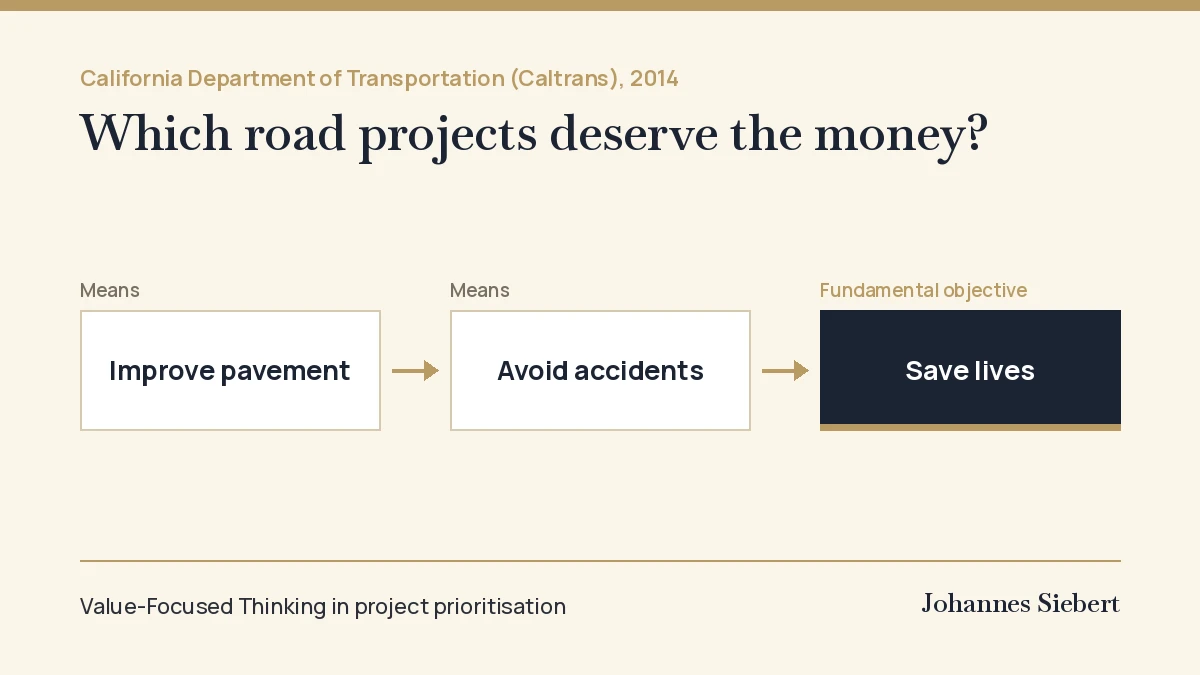
    Most of the criteria collected were means to an end rather than actual objectives. An example:

    Improve pavement → avoid accidents → save lives

    Only the last link is a fundamental objective – something we care about for its own sake. Evaluating means objectives and fundamental objectives together counts the same benefit twice. We did not have to invent the fundamental objectives from scratch: they could be derived directly from Caltrans’ new goals – maximise safety, minimise costs, minimise disruption of the economy and minimise inconvenience. Two further Caltrans goals, system performance and organisational excellence, depend more on the agency’s actions as a whole than on the selection of individual projects and therefore do not belong in the project evaluation.

    Making objectives measurable

    Each fundamental objective needs an attribute that measures how well an alternative achieves it. Sometimes there is a natural measure, such as cost in dollars. Sometimes a proxy measure has to do, such as accidents avoided instead of fatalities avoided. And sometimes it is worth constructing a dedicated measure that, for example, weights head-on collisions more heavily than minor accidents.

    Weights from trade-offs, not from ‘importance’

    The question ‘Which is more important, accidents or costs?’ has no meaningful answer. Is one avoided accident more important than a billion dollars? Hardly. More important than a thousand dollars? Probably. The only meaningful question is how much a specific change in one objective is worth compared with a specific change in another. If, for instance, one avoided accident is valued at two million dollars, a project that costs 120 million dollars and avoids 100 accidents creates a net value equivalent to 80 million dollars. Value judgements of this kind can be made explicit, discussed and checked against the organisation’s mission.

    What I took away

    The greatest leverage lay not in the calculation but in the question that comes before it: what does the organisation actually want to achieve with its projects? Once the fundamental objectives are clear, data requirements, weighting and communication become much easier. Good prioritisation starts with objectives, not with data.

    Postscript (September 2026): Building on our recommendations and further advice from Lee Merkhofer, the Caltrans team developed a prioritisation model based on Multi-Objective Decision Analysis, including a prototype, by June 2015. The Caltrans goals from which we derived the fundamental objectives in 2014 remained the agency’s official goals until 2020. Since then, Caltrans has reformulated them in two strategic plans; safety remains at the top, and economic prosperity is now a goal in its own right. Caltrans has published the final report of the pilot project, with our recommendations report in the appendix: SHOPP Pilot Project – Phase 1: A Framework for Project Prioritization (PDF, appendix).