Category: Research

  • A Media-Specific Balanced Scorecard Based on Value-Focused Thinking

    A Media-Specific Balanced Scorecard Based on Value-Focused Thinking

    Veröffentlichung

    Kunz, Reinhard; Siebert, Johannes U.; Mütterlein, Joschka. „A Media-Specific Balanced Scorecard Based on Value-Focused Thinking“, Journal of Media Business Studies, 13(4), 2016, 257-275. http://www.tandfonline.com/doi/full/10.1080/16522354.2016.1220114

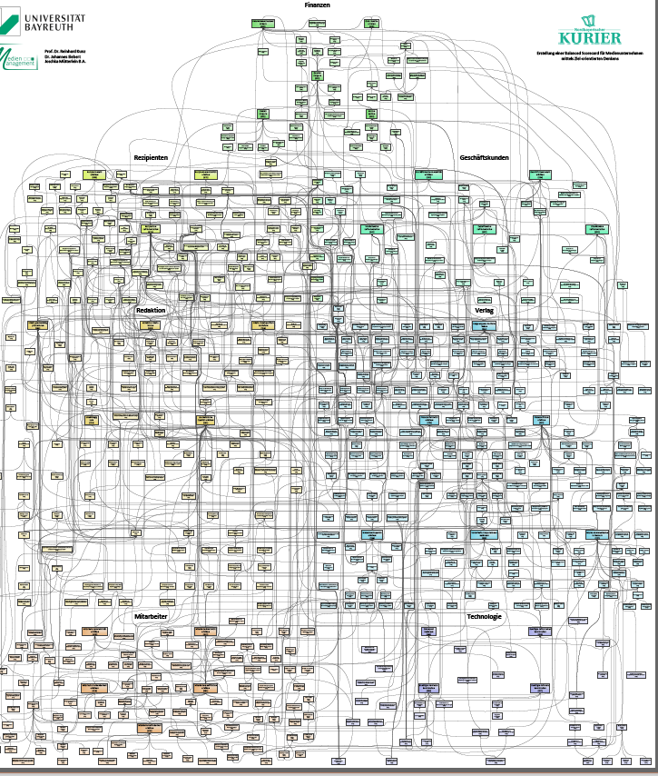
    Objectives are fundamental to strategic management. However, while research exists on objectives of media companies, we know little about the relationships between them. In order to advance research in this field, we used value-focused thinking to investigate the objectives of a media company and the balanced scorecard as a framework to demonstrate their relationships.

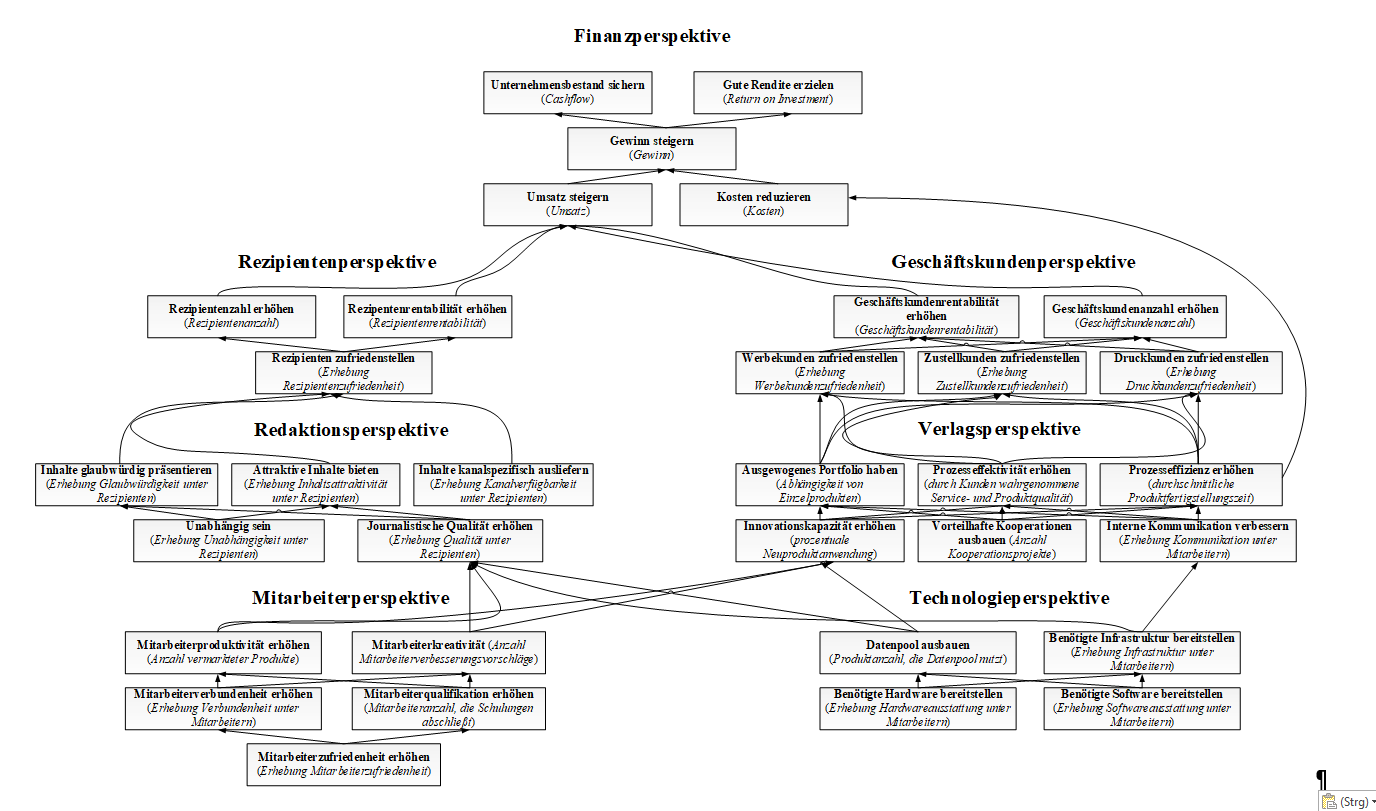
    In interviews with 23 managers and employees of a German medium-sized local newspaper company, we found 698 distinct objectives and 1009 relationships. By concentrating on the most important objectives, we derived a balanced scorecard with 33 objectives and 65 relationships organised in seven perspectives. The results were then validated in a second case study on a Czech national media group.

  • Combining Value‐Focused Thinking and Balanced Scorecard to Improve Decision‐Making in Strategic Management

    Combining Value‐Focused Thinking and Balanced Scorecard to Improve Decision‐Making in Strategic Management

    Zielorientierung ist der Schlüssel zum strategischen Management. In diesem Bereich ist die Balanced Scorecard eines der am häufigsten verwendeten Managementinstrumente. Sie strukturiert die Hauptziele eines Unternehmens aus verschiedenen Blickwinkeln auf der Grundlage der Unternehmensstrategie und verwendet Leistungsindikatoren, um die Erreichung der Ziele und der Strategie zu messen. Die Methode, mit der sie erstellt wurde, ist jedoch theoretisch nicht fundiert. Value-focused Thinking ist eine Entscheidungsphilosophie, die perfekt zur Erstellung der Balanced Scorecard passt. Sie stellt Methoden und Techniken zur Identifizierung und Strukturierung von Zielen zur Verfügung, die geeignet sind, eine Scorecard systematisch aus einem Mittel-Weg-Netz abzuleiten. Allerdings ist ein solches Mittel-Weg-Netz oft zu komplex für den dauerhaften Einsatz im strategischen Management. Durch die Anpassung der Struktur des Netzes an das Layout der Balanced Scorecard dient die fundierte und übersichtliche Menge der abgeleiteten Ziele und ihrer Messgrößen als sinnvolle Grundlage für die Anwendung von Methoden der multikriteriellen Entscheidungsfindung in einer Organisation.


    Ziel dieser Arbeit war es, ein Verfahren zu skizzieren, das die Balanced Scorecard und das Value-focused Thinking zusammenführt, indem es die Stärken der beiden Konzepte bewahrt und ihre Schwächen eliminiert. Es wurde ein sechsstufiger Prozess theoretisch entwickelt und in einer Fallstudie empirisch angewandt. Dieser Prozess umfasste (1) die Identifizierung von Zielen; (2) die Strukturierung von Zielen; (3) die Charakterisierung von Zielclustern; (4) die Formulierung von Mission, Vision und Strategie; (5) die Gestaltung der Scorecard; und (6) die Überwachung und Anpassung an Veränderungen. Auf der Grundlage dieses Ansatzes wurde eine Management-Scorecard erstellt, die die Strategieentwicklung und -umsetzung ermöglicht, ein klares und umfassendes Mittel-Zweck-Netz darstellt und die wichtigsten Ziele eines Unternehmens und ihre Beziehungen durch Perspektiven visualisiert, die grob an die Balanced Scorecard angelehnt sind. Es dient als Grundlage für die Forschung zur Verallgemeinerung und zum Vergleich von Erkenntnissen über Ziele von Organisationen. Unser Vorgehen zeigt, wie wissenschaftliche Methoden wie Value-focused Thinking den Instrumenten der Praktiker wie der Balanced Scorecard zugute kommen können und wie Management-Tools die wissenschaftlichen Methoden ebenfalls verbessern können.

    Kunz, Reinhard; Siebert, Johannes U.; Mütterlein. “Combining Value-Focused Thinking and Balanced Scorecard to Improve Decision-Making in Strategic Management”, Journal of Multi-Criteria Decision Analysis, September-December, 2016, 225-241DOI: 10.1002/mcda.1572

  • Designing a Media-Specific Balanced Scorecard by Applying Value-Focused Thinking

    Designing a Media-Specific Balanced Scorecard by Applying Value-Focused Thinking

    Publications

    Siebert, Johannes U.; Kunz, Reinhard „Entwicklung einer Balanced Scorecard mit Value-focused Thinking am Beispiel eines mittelgroßen Medienunternehmens“. Controlling: Zeitschrift für erfolgsorientierte Unternehmenssteuerung, March 2016, 210-215. DOI:  10.15358/0935-0381-2016-3-209

    Kunz, Reinhard; Siebert, Johannes; Mütterlein. “Combining Value-Focused Thinking and Balanced Scorecard to Improve Decision-Making in Strategic Management”, Journal of Multi-Criteria Decision Analysis, September-December, 2016, 225-241 DOI: 10.1002/mcda.1572

    Kunz, Reinhard; Siebert, Johannes; Mütterlein, Joschka. „A Media-Specific Balanced Scorecard Based on Value-Focused Thinking“, Journal of Media Business Studies, 13(4), 2016, 257-275. http://www.tandfonline.com/doi/full/10.1080/16522354.2016.1220114

    The Balanced Scorecard (Kaplan and Norton 1992) is one of the five management tools used most often and has been implemented by nearly 40 percent of the companies (Rigby and Bilodeau 2013). Yet, there is no theoretically sound approach for developing a balanced scorecard. Value-focused thinking is a decision-making philosophy that fits perfectly to Balanced Scorecard creation. It provides methods and techniques for the identification and structuring of objectives that are suitable to systematically derive a scorecard from a means-ends network. However, such a means-ends network is often too complex for enduring use in strategic management. By adapting the network’s structure to the Balanced Scorecard’s layout, the profound and clear set of derived objectives and their measures provide a reasonable basis for applying methods of multi-criteria decision-making in an organization. In a case study, we develop a media-specific Balanced Scorecard to provide media decision-makers with a model that takes characteristics of media management into account and that helps to manage their company successfully. Using a scientifically sound approach that is based on value-focused thinking (Keeney, 1992), we interview the publisher, the CEO, nine management representatives, and ten key employees of a German medium-sized local newspaper company. Overall, 698 distinct objectives and 1,009 relationships are identified. By concentrating on the most important objectives, we derive a Balanced Scorecard with 33 objectives and 65 relationships, which are organized in seven perspectives. Because of its innovativeness, this project was runner-up in the final of the Practice Awards der Decision Analysis Society (INFORMS).

  • Developing and Validating the Multidimensional Proactive Decision-Making Scale

    Developing and Validating the Multidimensional Proactive Decision-Making Scale

    Veröffentlichung

    Siebert, Johannes U.; Kunz, Reinhard. “Developing and Validating the Multidimensional Proactive Decision-Making Scale”. Special Issue „Behavioral Operations Research“ in European Journal of Operational Research, 249(3) 2016, 864-877.dx.doi.org/10.1016/j.ejor.2015.06.066

    On the basis of an extensive interdisciplinary literature review proactive decision-making (PDM) is conceptualised as a multidimensional concept. We conduct five studies with over 4,000 participants from various countries for developing and validating a theoretically consistent and psychometrically sound scale of PDM.

    The PDM concept is developed and appropriate items are derived from literature. Six dimensions are conceptualised: the four proactive cognitive skills ‘systematic identification of objectives’, ‘systematic search for information’, ‘systematic identification of alternatives’, and ‘using a ‘decision radar’’, and the two proactive personality traits ‘showing initiative’ and ‘striving for improvement’. Using principal component factor analysis and subsequent item analysis as well as confirmatory factor analysis, six conceptually distinct dimensional factors are identified and tested acceptably reliable and valid.

    Our results are remarkably similar for individuals who are decision-makers, decision analysts, both or none of both with different levels of experience. There is strong evidence that individuals with high scores in a PDM factor, e.g. proactive cognitive skills or personality traits, show a significantly higher decision satisfaction. Thus, the PDM scale can be used in future research to analyse other concepts. Furthermore, the scale can be applied, e.g. by staff teams to work on OR problems effectively or to inform a decision analyst about the decision behaviour in an organisation.

  • Identifying and Structuring the Objectives of the Islamic State of Iraq and The Levant (Isil) and its Followers

    Identifying and Structuring the Objectives of the Islamic State of Iraq and The Levant (Isil) and its Followers

    Veröffentlichung

    Siebert, Johannes U.; von Winterfeldt, Detlof; John, Richard. “Identifying and Structuring the Objectives of the “Islamic State of Iraq and the Levant” (ISIL) and its Followers.” Decision Analysis (INFORMS), 2016, 13(1), 26-50, dx.doi.org/10.1287/deca.2015.0324

    This study addressed three questions: 1. What are the objectives of the leaders of ISIL? 2. What are the objectives of the followers of ISIL? 3. How are the two sets of objectives related? To answer these questions we analyzed the transcripts of interviews and presentations of 59 subject matter experts (SMEs) and conducted a separate analysis of speeches of ISIL leaders and selected Internet sources. In both efforts we identified and structured the strategic, fundamental, and means objectives of ISIL and its followers.

    The results indicate that ISIL’s leaders pursue four strategic objectives: Establish a Caliphate in Iraq and the Levant, Control and Govern the Caliphate, Expand Islam and Sharia Law Worldwide, and Recreate the Power and Glory of (Sunni) Islam. The followers’ objectives can be partitioned into three strategic objectives: Humanitarian Fulfillment, Religious Fulfillment and Personal Fulfillment.

    The objectives identified from the SME interviews were similar to those identified from ISIL leaders’ statements and the Internet. However, the Internet search revealed many more personal objectives of ISIL followers. The results further indicate that ISIL’s leadership objectives are closely aligned with those of its followers. There also is a sharp contrast between the objectives of ISIL and those of Al Qaeda, particularly ISIL’s emphasis on occupying and controlling territories in Iraq and Syria vs. Al Qaeda’s focus on worldwide jihad.

  • Creating More and Better Alternatives for Decisions Using Objectives

    Creating More and Better Alternatives for Decisions Using Objectives

    Veröffentlichung

    Siebert, Johannes U.; Keeney, Ralph L. “Creating More and Better Alternatives for Decisions Using Objectives”. Operations Research, September/October 2015, 63(5), 1144-1158. dx.doi.org/10.1287/opre.2015.1411

    The quality of alternatives is crucial for making good decisions. This research, based on five empirical studies of important personally relevant decisions, examines the ability of decision makers to create alternatives for their important decisions and the effectiveness of different stimuli for improving this ability. For decisions for which the full set of potentially desirable alternatives is not readily apparent, our first study indicates that decision makers identify less than half of their alternatives and that the average quality of the overlooked alternatives is the same as those identified. Four other studies provide insight about how to use objectives to stimulate the alternative-creation process of decision makers and confirm with high significance that such use enhances both the number and quality of created alternatives. Using results of the studies, practical guidelines to create alternatives for important decisions are presented.

  • Constructing a comprehensive strategic objectives network for an Energy Supplier

    Constructing a comprehensive strategic objectives network for an Energy Supplier

    Germany is facing a huge disruptive change in its energy system. The speed of the transition from the fossil fuel and nuclear energy age to the renewable energies had been tremendously accelerated after Fukushima and the government´s decision to phase out of nuclear energy in the next 10 years. Therefore, traditional German utilities must make far-reaching decisions for ensuring long-term competitiveness. For that purpose, they need to define the future strategy and to agree on the right steps for its implementation. In the following 20 years decentralized renewable energy solutions, cost intensive offshore wind parks and the decommissioning of centralized conventional power plants have to be planned and realized. However, like in other industries, there is the tendency to deal with various decision problems isolated from each other without focusing on the big picture. Thereby it is often only vague defined what and how should be achieved. Furthermore, the search of alternatives is based on traditional thinking, which is likely to mislead in such a never before experienced disruptive change.

    Value-focused Thinking provides a holistic approach. It requests that companies should identify their values, i.e. what they care about, and translate these values into objectives (what should be achieved). The objectives are then be used to create systematically alternatives and identify decision opportunities (how this could be achieved). Generally, this procedure yields alternatives, which the company was not aware of before.

    In the case example, Prof. Ralph Keeney (Duke University) and I had discussions of about one hour with each of 19 employees of a big energy supplier (over 20 billion Euro turnover), including all members of the management board. The goal of each discussion was to access all thoughts of each individual that might be important for creating strategic objectives. After the discussion with each individual, we converted its thoughts into objectives. The initial step was simply to combine the 19 individual lists. This combined lists compassed approximately 450 total objectives. Next, we organized the objectives into categories that address different concerns. In this process, we had to develop the categories and then assign individual objectives on the list to appropriate categories. This process is done iteratively and hierarchically and results in a comprehensive network of strategic objectives (NOSO).

    In addition, a great benefit of the entire process was that the horizon of the interviewees is broadened through the interviews. In the project involving the German energy provider, this benefit is illustrated by a quotation of the personal assistant of a board member who was listening in the interview with her superior: “I work for him since half a year, but I never heard him thinking and arguing in such a broad manner”. Furthermore, the CEO said after the final presentation: “The clear structure of objectives helps me to better understand my company and will be certainly helpful to communicate my idea of my company to my employees as well as the Board of Directors.” This shows the level of stimulation that such a procedure can create.