Author: admin

  • Decision-making competence can be taught – and tested

    Decision-making competence can be taught – and tested

    On 8 September I received the Ars Docendi Anerkennungspreis – the recognition award of the Austrian Federal Ministry of Women, Science and Research – in Vienna, in the category “socially and sustainability-oriented teaching”, for the course design “From subject knowledge to judgement: developing decision-making competence systematically”. I am glad about the recognition. What matters more to me is the question behind it: why do we assume so readily in higher education that students can decide – and teach it so rarely?

    What happens in the course

    Over one semester, students work on real decision problems from business, politics and society: from logistics strategies to sustainability- and technology-related challenges. They clarify their objectives, develop courses of action, compare economic, social and environmental effects, and derive a reasoned recommendation.

    The difference from a classical case study lies at the very beginning. In a case study the problem is given and the analysis is open; here it is the other way round. Students first have to work out which decision is actually at stake and which objectives are attached to it. Only then does the methodological toolkit pay off.

    Not a didactic aspiration but a testable claim

    Students should not learn to reproduce supposedly correct answers, but to make defensible decisions under uncertainty. Decision-making competence can be learned, examined and measured. This is not a programme statement: it shows up in the course evaluations.

    Embedded in the curriculum, not offered as an elective

    A course design only takes effect if it does not depend on the accident of course selection. At MCI, “Responsible Decision Making” is one of the learning goals of the bachelor programmes and is reviewed within the Assurance of Learning process of the accreditation body AACSB. The award-winning design is embedded in six bachelor programmes, so it reaches more than those who are interested anyway.

    What students take away

    “What I learned in this course I still apply today. I approach complex decisions differently than before – more structured, and with more clarity about what actually matters to me.” Julian Pfurtscheller, Chair of the MCI student union and a former student

    What the award says – and what it does not

    The Ars Docendi Anerkennungspreis honours a single course design. That is a different object from the recognitions that have come in the same period. CEEMAN, the international association for management development, will present me with the Champion Award in the category “Teacher of the Year 2026” in Bucharest on 24 September; that award refers to teaching performance as a whole. The Society of Decision Professionals recognised my engagement in advancing and applying decision analysis with the Inspirational Achievement Award, and the International Academy of Information Technology and Quantitative Management recognised my research with the Richard Price Award.

    Four awards, four different objects. What connects them is the conviction that deciding is an ability, not a character trait.

    Learning to decide does not make you more certain. It makes your choices better founded.

    About the award

    Ars Docendi – Austrian State Prize for Excellence in Teaching. Recognition award (Anerkennungspreis) in the category “socially and sustainability-oriented teaching”, presented by the Federal Ministry of Women, Science and Research in Vienna on 8 September 2026. Brochure→   ·   Press release →  

  • Richard Price Award for MCI Professor Johannes Siebert

    Richard Price Award for MCI Professor Johannes Siebert

    Recognition for contributions to Data Science and its application in planning and prioritization decisions

    Johannes Siebert, Professor of Decision Sciences, Behavioral Economics and Supply Chain Management at MCI | The Entrepreneurial School®, has received the Richard Price Award from the International Academy of Information Technology and Quantitative Management (IAITQM) and has also been elected a “Fellow” of the Academy. The award was presented at the 13th International Conference on Information Technology and Quantitative Management (ITQM 2026) in Rouen. The Richard Price Award honors individuals who have made outstanding contributions to the theory, methodology and application of Data Science. The award is named after Richard Price, whose posthumous publication of Bayes’ theorem laid a foundation for modern data-based inference.

    With the award, IAITQM recognizes Siebert’s work at the interface of Data Science and decision-making. His research program combines data-driven and AI-supported approaches with multicriteria decision methods and provides methodologically sound, empirically validated approaches for translating analytical results into well-founded resource and capital allocation decisions under uncertainty. The practical viability of this approach is demonstrated by high-level applications for which Siebert has been nominated several times for the Decision Analysis Practice Award (INFORMS): For Bayer AG, he developed the evaluation model for prioritizing a project portfolio (published in Decision Analysis, INFORMS, 2022); he advised the California Department of Transportation (Caltrans) on developing the methodological model for allocating an annual infrastructure budget in the double-digit billions of US dollars.

    “Data Science is fundamentally changing how decisions are made – at the same time, the importance of structured, value-focused decision processes has never been greater. This recognition encourages me to continue advancing this field in research, practice and teaching,” says Johannes Siebert.

    At MCI, Siebert conducts research and teaches in data-based decision-making, Business Analytics, Behavioral Economics and multicriteria methods, with a particular focus on the role of Artificial Intelligence in entrepreneurial planning, prioritization and control decisions. This orientation strengthens innovation, digitalization and future-oriented capabilities in academia and business alike. Beyond research, Siebert brings his findings into decision education programs, thereby extending the impact of decision competence beyond the university.

    “This recognition underscores the international significance of MCI research in the fields of Entrepreneurship and Decision Making. It shows that innovative research on entrepreneurial action and intelligent decision-making is recognized worldwide and sustainably strengthens MCI’s international reputation,” adds MCI-Head of Research & Development Martin Pillei.

    Siebert’s academic references include a paper co-authored with Ralph L. Keeney (Duke University) in Operations Research, one of the world’s leading journals in the field. His work has also received extensive international recognition: the Inspirational Achievement Award of the Society for Decision Professionals (SDP), the Best Research Paper Award of the Decision Sciences Journal of Innovative Education (2023), finalist status for the European Award for Excellence in Teaching in the Social Sciences and Humanities, and a TEDx talk with more than 175,000 views.

    The original press release can be found here: https://www.mci.edu/en/news-filter-en/117-studyprogram-news/276-news-business-management-for-professionals/7387-richard-price-award-for-mci-professor-johannes-siebert

  • Deciding for a Secure Tomorrow: Proactive Decision-Making and Retirement Financial Planning Behavior

    Deciding for a Secure Tomorrow: Proactive Decision-Making and Retirement Financial Planning Behavior

    Retirement financial planning behavior (RFPB) encompasses the concrete actions individuals take to prepare financially for retirement. We examine RFPB from an Operational Research (OR) perspective using Decision Analysis (DA) principles—decision quality and value-focused thinking—operationalized via proactive decision-making (PDM), which integrates DA-grounded proactive cognitive skills (PCS) with proactive personality traits derived from the organizational behavior literature. Using cross-sectional survey data from 457 UK adults and structural equation modelling with systematic model comparisons and multigroup tests, we assess whether PDM influences RFPB through four psychological traits—propensity to plan, confidence in financial information search, willingness to accept investment risk, and general self-efficacy—and whether relationships differ by financial literacy and numeracy. Results show that PDM affects RFPB entirely through these psychological traits (full mediation), with PCS—the trainable, DA-grounded decision-analytic skills—serving as the operative mechanism, while proactive personality traits are non-significant in this pathway. The mediated model explains 57.1% of RFPB variance and outperforms partial-mediation, traits-only, and reverse-causality alternatives. Multigroup analyses indicate that the indirect structure holds across financial literacy and numeracy groups, with patterns suggesting a compensatory role of PCS under lower financial literacy. Together, the evidence links DA-grounded decision-analytic skills to RFPB. Our findings highlight the potential of PCS-focused decision-analytic competence training as an OR-relevant mechanism to promote RFPB, complementing financial literacy and numeracy programs. Additionally, our study complements optimization-focused OR approaches to retirement financial planning by identifying PCS as a decision-analytic lever that strengthens RFPB—the behavioural precondition for adopting such optimized prescriptions in practice.

    Siebert, Jana; Siebert Johannes U., Blösl, Florian; “Deciding for a Secure Tomorrow – Examining Proactive Decision-Making and Retirement Planning Behavior”, European Journal of Operational Research) (in press), https://doi.org/10.1016/j.ejor.2025.10.021

  • MCI Professor Johannes Siebert Receives Prestigious SDP Award

    MCI Professor Johannes Siebert Receives Prestigious SDP Award

    International recognition honors outstanding contributions to data-driven decision-making, supply chain management, and societal impact | Award presented at the 32nd SDP Annual Conference at the University of Massachusetts in Boston

    Johannes Siebert, Professor of Decision Sciences, Behavioral Economics, and Supply Chain Management at MCI, has been honored with the “Inspirational Achievement Award” by the Society for Decision Professionals (SDP). This internationally renowned award was presented during the 32nd SDP Annual Conference at the University of Massachusetts in Boston, recognizing exceptional achievements in decision analysis and outstanding commitment to advancing the field.

    At MCI, Johannes Siebert conducts research and teaching in the field of decision analysis, with a strong focus on data-driven decision-making, behavioral economics, and multi-criteria methods. A particular emphasis lies on the role of artificial intelligence in decision processes, as well as on making decision quality measurable and trainable – key aspects in fostering innovation, digitalization, and future competencies in both academia and industry.

    “Decision science is at a turning point: artificial intelligence is transforming how decisions are made. However, at the same time, the importance of structured, value-focused decision processes has never been greater. This award strongly motivates me to further advance the field across research, practice, and teaching,” says Johannes Siebert.

    Johannes Siebert regularly contributes his expertise to international applied projects for both private and public sector partners, including initiatives in the energy, transportation, and pharmaceutical industries. His achievements have earned him multiple nominations for the Practice Award of the Decision Analysis Society. His excellence in teaching has also received international recognition, including a finalist nomination for the highly regarded European Award for Excellence in Teaching in Social Sciences and Humanities.

    MCI Rector Andreas Altmann adds: “This award highlights what MCI stands for: excellence in research, strong practical orientation, and active engagement with key societal challenges. Johannes Siebert exemplifies these values and strengthens MCI’s international reputation as a leading institution in decision sciences and management education.”

    The original press release can be found here: https://www.mci.edu/en/media-en/news/7127-mci-professor-johannes-siebert-receives-prestigious-sdp-award

  • Fifty years of decision analysis in operational research: A review

    Fifty years of decision analysis in operational research: A review

    We review the development of research in Decision Analysis (DA) over the past fifty years. After presenting the axiomatic foundations and discussing the DA process, we start with value-focused thinking as a problem structuring method. We then analyze the model building phase, with a focus on graphical models for decision-making under uncertainty: belief networks, decision trees, and influence diagrams. Next, we analyze how DA research has dealt with uncertainty focusing on the areas of elicitation, aggregation, and evaluation. We then discuss sensitivity analysis, describing local and global techniques, from one-way sensitivity analysis to the value of information. Finally, we review the literature on information acquisition and discuss the role of information value in this context

    Borgonovo, Emanuele; José, Victor, R. R, Shachter, Ross; Siebert, Johannes U; Ulu, Canan. “Fifty Years of Decision Analysis in Operational Research: A Review” (Invited Review on occasion of the celebration of the 50th Anniversary of EURO (the European association of Operational Research Societies), European Journal of Operational Research) https://doi.org/10.1016/j.ejor.2025.05.023

  • ChatGPT vs. Experts: Can GenAI Develop High-Quality Organizational and Policy Objectives?

    ChatGPT vs. Experts: Can GenAI Develop High-Quality Organizational and Policy Objectives?

    This paper explores the efficacy of generative artificial intelligence (GenAI) for value-focused thinking, specifically its ability to generate high-quality sets of objectives for organizational and policy decisions. Overall, we find that while most GenAI-generated objectives are individually viable, the objective sets as a whole exhibit substantial shortcomings. They often include nonessential considerations, omit important objectives, and lack structure due to redundancy and poor decomposability. A key issue is the tendency of GenAI to include means objectives, even when explicitly instructed not to do so.

    At the same time, we show that the quality of objective sets can be significantly improved by applying best practices in prompting and incorporating decision analysis (DA) expertise. The findings highlight the importance of a human-in-the-loop approach: GenAI is useful for generating initial objective ideas, but expert input from decision analysts is essential before using the results to support real-world decision making.

    To operationalize this, we present and demonstrate a four-step approach that combines the complementary strengths of GenAI and decision analysts.

    PLease more information in the MCI-press release: https://www.mci.edu/en/news-filter-en/117-studyprogram-news/276-news-business-management-for-professionals/7208-mci-research-where-ai-ends-human-expertise-beginshttps://www.mci.edu/en/news-filter-en/117-studyprogram-news/276-news-business-management-for-professionals/7208-mci-research-where-ai-ends-human-expertise-begins

    Simon, Jay; Siebert, Johannes U. ChatGPT vs. Experts: Can GenAI Develop High Quality Organizational and Policy Objectives? Decision Analysis (in press). https://doi.org/10.1287/deca.2025.0387

  • Linear Transformation of One-Dimensional Utility Functions: Empirical Study on the Impact on the Final Ranking of Alternatives in Personal Decisions

    Linear Transformation of One-Dimensional Utility Functions: Empirical Study on the Impact on the Final Ranking of Alternatives in Personal Decisions

    Determining one-dimensional utility functions for each objective in multiattribute utility theory (MAUT) requires substantial time and cognitive effort from decision makers. They must account for decreasing or increasing marginal utility as well as their individual risk attitudes, often resulting in nonlinear utility functions. This assessment process is prone to errors and distortions.

    In this study, we analyze the extent to which a linear transformation of one-dimensional utility functions compromises decision quality. Specifically, we examine three aspects: the use of (non)linear utility functions, their impact on the ranking of alternatives, and the stability of the best alternatives depending on utility differences under the assumption of linearity.

    Our analysis is based on 2,536 carefully modeled personal decisions conducted by students using the decision support tool Entscheidungsnavi. The results show that 95.9% of participants used at least one nonlinear utility function, and 76.4% of all objectives were evaluated nonlinearly. Simplifying preference-accurate utility functions through linearization led to a rank reversal of the best alternative in 15.5% of the decisions. The set of the top three alternatives changed in 14% of the cases. However, in 98.8% of the decisions, the best alternative remained within the top three under the assumption of linear utility functions.

    Based on these findings, we recommend determining utility functions as preference-accurately as possible, including nonlinearities, especially for important decisions. However, no rank reversal of the best alternative was observed when the absolute utility difference between the best and second-best alternative exceeded 0.27 under linearity. In such cases, assuming linear utility functions can be a useful simplification to save time and effort.

    Tönsfeuerborn, M., von Nitzsch, R., & Siebert, J. U. (2026). Linear transformation of one-dimensional utility functions: Empirical study on the impact on the final ranking of alternatives in personal decisions. Decision Analysis, 23(1), 46–64. https://doi.org/10.1287/deca.2024.0317
     

  • Teaching is described by its methods. It should be judged by its goals.

    Teaching is described by its methods. It should be judged by its goals.

    I was shortlisted for the European Award for Excellence in Teaching in the Social Sciences and Humanities. Central European University has presented it since 2011 to academics teaching in the European Higher Education Area; it carries the Diener Prize of 5,000 euros. The award went to another candidate in early September. The outcome occupies me less than something I noticed while assembling the application.

    A dossier forces you to write things down

    An application of this kind requires you to document your own teaching: course descriptions, assessment concepts, feedback from students and from colleagues, an account of your understanding of teaching. Anyone doing this inevitably reads other teaching concepts, calls for applications and accreditation documents as well. A regularity stands out: almost all of them describe first how teaching is done — blended learning, project-based work, digital tools — and only afterwards what it is meant to achieve. The second part often remains implicit.

    The difference between means and ends

    In decision analysis this distinction is central. A fundamental objective is what you pursue for its own sake. A means objective matters only because it contributes to a fundamental objective. Flipped classroom, peer feedback, AI-supported tools: all of them means. They are replaceable as soon as something better becomes available.

    The order is not merely a question of presentation. It determines which alternatives come into view at all.

    Start with methods and you vary what you already know. Start with objectives and you arrive at alternatives that do not appear in the catalogue of methods.

    That may mean different assessment formats, different assignments, and sometimes the conclusion that a piece of content has no place in the curriculum.

    The question that should come first

    What should graduates be able to do that they could not do without this degree? My answer: they should be able to structure a decision under uncertainty so that they can justify it to themselves and to others. Subject knowledge is a precondition for this, not the result. That answer implies something different from a catalogue of methods: assessments in which students document a decision of their own instead of reproducing models; projects on questions with no known solution; criteria that address the process rather than the result.

    I regard this order as the point at which teaching development is decided.

    What remains

    For me the value of such procedures lies not in their outcome but in the compulsion to be explicit. You have to write down what you otherwise take for granted, and in doing so you notice where the justification gets thin. That does not require a prize. It is enough to read one of your own course descriptions with a single question in mind: does it say what all this is good for — or only how it is done?

    About the award: European Award for Excellence in Teaching in the Social Sciences and Humanities, presented by Central European University — elkana.ceu.edu

    Further reading: MCI news item of 29 September 2025 on the shortlist nomination

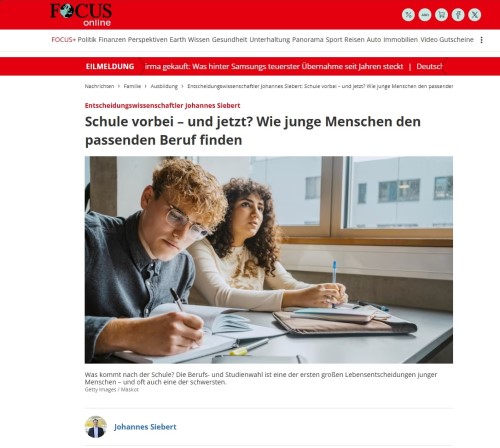
  • Decision scientist Johannes Siebert: School over – now what? How young people find the right career

    Decision scientist Johannes Siebert: School over – now what? How young people find the right career

    What comes after school? Choosing a career and course of study is one of the first significant decisions young people make in life—and often one of the most challenging. Decision scientist Prof. Johannes Siebert explains why it is more than just a “compulsory program” and what opportunities it offers.

    Many young people are currently asking themselves: “What am I going to do after school?” Why is this decision so important?

    For many of them, choosing a career or course of study is one of the first significant decisions they must make independently. It not only influences their professional career, but also their self-confidence and their prospects. In short: their lives. It is often possible to change the initial decision to study or do vocational training without a great deal of bureaucracy.

    However, as surveys show, this often results in considerable individual psychological stress for young people – not to mention the overall economic consequences, such as an increased shortage of skilled workers and lower economic productivity due to delayed career entry.

    Read the full article here (in German): https://www.focus.de/familie/ausbildung/entscheidungswissenschaftler-johannes-siebert-schule-vorbei-und-jetzt-wie-junge-menschen-den-passenden-beruf-finden_22435455-3583-4c2a-8981-3b80dd727a0b.html

    Please stay current and do not miss any of my contributions on Focus Online. Follow me and network with me for exciting insights and current discussions. I look forward to exchanging ideas with you! https://www.linkedin.com/in/johannes-siebert/

  • Sound decisions are the key

    Sound decisions are the key

    At the second Education Summit of the Employers’ Associations of Lower Saxony I spoke about the question career orientation usually skips: young people learn a great deal about which paths exist – and almost nothing about how to choose between them.

    Talk: Sound decisions are the key – Career orientation through decision analysis
    Event: 2nd UVN Education Summit, “Career orientation as the key to success”
    Date and venue: 19 March 2025, Karriere-Campus Hannover
    Host: Unternehmerverbände Niedersachsen e.V. (UVN)
    Event page (UVN)  ·  Recording of the summit

    Around 250 guests from business, schools and politics came together at the Karriere-Campus in Hannover. The political line-up showed how much weight the topic carries in Lower Saxony: two state ministers took part – Minister of Education Julia Willie Hamburg and Minister of Economic Affairs Olaf Lies, now Minister-President of the state.

    Postponing is a decision too

    Roughly one in three young people drops out of vocational training or university study shortly after starting – with consequences for the skills shortage and a considerable burden on the individuals themselves. One reason is rarely named: many young people see decisions as problems to be solved. Solving problems is unpleasant, so they put it off. At some point the window closes and only the leftovers remain. Or they do “nothing for now” – and the first “nothing for now” is usually followed by a second.

    We need to inspire young people not only about careers, but about choosing one.

    Decision competence is the missing building block

    Internships, aptitude tools, careers fairs, open days: the existing offerings achieve a great deal, and they have one thing in common – they widen the range of choices. What they cannot do is make the choice. That requires the ability to decide independently and on a sound basis. Decision competence therefore does not compete with established career orientation; it is the building block that makes it effective.

    I illustrated this with KLUGentscheiden, which I initiated as a research project at the University of Bayreuth. Using methods from decision analysis, we break a student’s decision down into manageable steps together with them: clarify objectives, develop alternatives, bring the two together. Our digital tool KLUGnavi supports the analysis. The evaluation shows that afterwards students perceive the choice of career or study programme as less difficult and rate themselves as more proactive and more self-efficacious (Siebert, Becker & Oeser, 2023, Decision Sciences Journal of Innovative Education 21(1), 10–25).

    The bottleneck is anchoring it in schools

    Teachers’ interest is considerable – in Bavaria alone we have trained more than 400 of them as multipliers, and the materials are available free of charge. The real hurdle comes afterwards: it is precisely the most committed teachers who meet resistance when they try to establish the programme permanently at their school.

    Saarland shows how it can work. There, “KLUGentscheiden! goes Saar” – funded by the statutory health insurance funds and run together with the Landesamt für Pädagogik und Medien and the Ministry of Education and Culture – is working on exactly that until 2027: adapting the materials to different timetable formats, qualifying teachers through train-the-trainer sessions, and handing delivery over to the schools themselves. That kind of structural anchoring is what is needed – and it is what I spoke about in Hannover.

    More on materials and teacher training: klugentscheiden.org