
Category: Blog-en

  • Identifying and structuring of the objectives of the terrorist group Islamic State

    Identifying and structuring of the objectives of the terrorist group Islamic State

    Veröffentlichung

    • Siebert, Johannes; von Winterfeldt, Detlof; John, Richard. “Identifying and Structuring the Objectives of the “Islamic State of Iraq and the Levant” (ISIL) and its Followers.” Decision Analysis (INFORMS), 13(1), 26-50. (Link)
    • Nagata, M., Abbas, A., Atran, S., Braniff, B., Bringuel, A., al-Chalabi, M., …. & Corman, S. (2014). Multi-‐Method Assessment of ISIL. (Link)
    • https://www.informs.org/Blogs/DECA-Blogs/DECA-Review/Identifying-and-Structuring-the-Objectives-of-the-Islamic-State-of-Iraq-and-the-Levant-ISIL-and-its-Followers (Link)
    • „Wer dem IS folgt, ist ein Loser“, in Welt am Sonntag, No. 4, 24th of January, 2016. (Link)
    • „Was macht den IS für Anhänger attraktiv?“, N24.de, 25th of January, 2016, (Link)

    In summer 2014, the terrorist group Islamic State was one of the most severe threats for the civilian population in the Middle East as well as in the West. The American government did not had a clear strategy how to deal with this new threat. Pres. Obama even admitted this in public (“We don’t yet have a complete strategy” for fighting the Islamic State in Iraq; 28. August 2014, in Washington Post).

    One of the main problems of the military leadership in the US was that the means, which were successful to protect the civilians against a terrorist group Al Qaeda, did not had the same impact to protect civilians against the terrorist group Islamic State. In the retrospective view, the main reason was that both terrorist groups pursue fundamentally different strategies. In order to pursue meaningful and effective measures to protect civilians it was necessary to identify the objectives of the terrorist group Islamic state. If you know what your opponent wants, it is much easier for you to prevent it.

    General Nagata, Head of Special Operations Command Central (SOCCENT) sent at the end of August 2014 an urgent request to the Center for Risk and Economic Analysis of Terrorism Events (CREATE) at University of Southern California to find out, what the terrorist group Islamic State wants, i.e., the objectives the leaders of the followers, and why they are so attractive to their followers. This task is particularly difficult, because there is no access to the leaders and members of the terrorist group Islamic state for interviewing them. Therefore, the Office of the Joint Chief of Staff in the Pentagon reached out to 59 subject matter experts with backgrounds in terrorism research, Islam, political science, military strategy, the Middle East, peace research, etc. and conducted semi-structured interviews. Prof. von Winterfeldt, one of the worldwide leading counterterrorism researchers and founding director of CREATE, analyzed these interviews to identify and structure the objectives of the leadership and the followers of Islamic State. Prof. Siebert took the lead in the second, separate effort solely based on open sources available on the Internet, for example primary sources such as transcribed speeches of Islamic State leaders or secondary sources such as newspaper articles or scientific papers. In the next step, both separately and independently derived objectives hierarchies were compared and merged. There was a great deal of overlap and similarity.  However, the researchers also found some notable differences, especially regarding the followers’ objectives, which could be explained primarily by the different sources used.

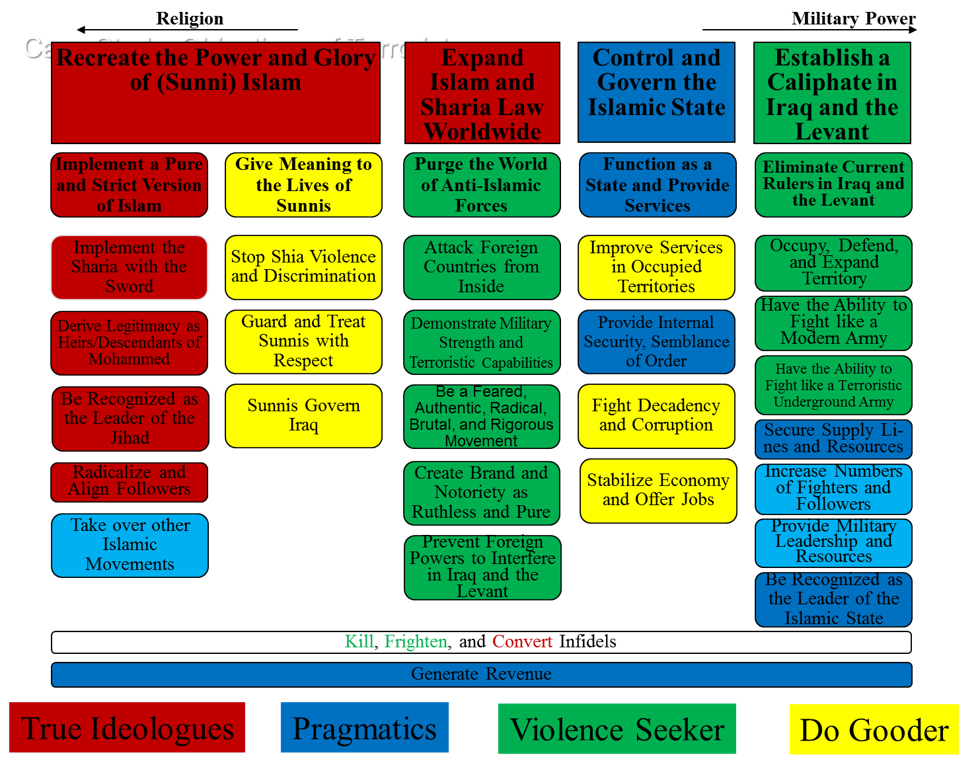
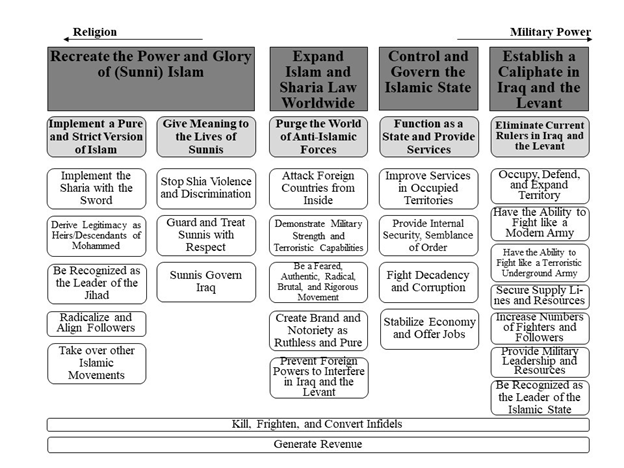
    The results indicate that Islamic State’s leaders pursue four strategic objectives “Establish a Caliphate in Iraq and the Levant”, “Control and Govern the Caliphate”, “Expand Islam and Sharia Law Worldwide”, and “Recreate the Power and Glory of (Sunni) Islam”. The followers’ objectives can be partitioned into three strategic objectives: Humanitarian Fulfillment, Religious Fulfillment and Personal Fulfillment. The objectives identified from the subject matter expert interviews were similar to those identified from Islamic State leaders’ statements and the Internet. However, the Internet search revealed many more personal objectives of Islamic State followers. The results further indicate that Islamic State`s leadership objectives are closely aligned with those of its followers. There also is a sharp contrast between the objectives of Islamic State and those of Al Qaeda, particularly Islamic State’s emphasis on occupying and controlling territories on Iraq and Syria vs. Al Qaeda’s focus on worldwide jihad. The objectives hierarchy of the leaders of Islamic state is illustrated in the following figure.
    This study resulted in a successful publication in the INFORMS journal Decision Analysis. In addition, the editor of Decision Analysis, found that the importance of the study warranted the creation of a media campaign through special announcements and a blog, the first time that this journal has made such an effort. Perhaps more importantly, the work made an impact on a major policy area by providing a report to General Nagata and the US Special Operations Unit in the Middle East. The study was nominated for the final of the Practice Award of the INFORMS Decision Analysis Society because of the high level of novelty of the methods to systematically identify and structure objectives of an organization when there is no access to the decision-maker and the high impact on the real world. A detailed description of the method and results, the project report and selected media coverage can be found in the following
  • Developing methods for identifying, structuring and comparing objectives

    Developing methods for identifying, structuring and comparing objectives

    Veröffentlichung

    Siebert, Johannes; von Winterfeldt, Detlof; John, Richard. “Identifying and Structuring the Objectives of the “Islamic State of Iraq and the Levant” (ISIL) and its Followers.” Decision Analysis (INFORMS), 2016, 13(1), 26-50

    Siebert, Johannes U.; von Winterfeldt, Detlof. „Comparative Analysis of Terrorists’ Objectives Hierarchies“, Decision Analysis (INFORMS) June 2020, 17(2), 97-114, https://doi.org/10.1287/deca.2019.0400

    Identifying the objectives of a hostile organization whose decision-makers are not interested in cooperation or even contact with them might be dangerous. In such a case, the methods to identify objectives in a cooperative organizations cannot be applied. We developed a method to identify the objectives of a hostile organization using expert interviews and published speeches of their leaders. The method can also be applied in more moderate cases and could find widespread application, for example, to identify a competitor’s objectives. Furthermore, we developed a method to compare the objectives hierarchies of two or more organizations of one organization over time. The identification of such differences is crucial if they have a substantial impact. For example, to ensure the protection of the civilian population in the Middle East, Europe, and the United States concerning attacks by the terrorist group Islamic State it is necessary to identify similarities and differences of the objectives of Al Qaeda and Islamic State. The results can be used to analyze which measures that had been successful and effective against Al Qaeda could be transferred against Islamic State which not.

  • Comparative Analysis of Terrorists’ Objectives Hierarchies

    Comparative Analysis of Terrorists’ Objectives Hierarchies

    To develop effective counterterrorism strategies, it is important to understand the capabilities and objectives of terrorist groups. Much of the understanding of these groups comes from intelligence collection and analysis of their capabilities. In contrast, the objectives of terrorists are less well understood. In this article, we describe a decision analysis methodology to identify and structure the objectives of terrorists based on the statements and writings of their leaders. This methodology was applied in three case studies, resulting in the three objectives hierarchies of al-Qaeda, Islamic State of Iraq and the Levant (ISIL), and Hezbollah. In this article, we propose a method to compare the three objectives hierarchies, highlight their key differences, and draw conclusions about effective counterterrorism strategies. We find that all three terrorist groups have a wide range of objectives going far beyond the objective of killing and terrorizing people in the non-Muslim world. Among the shared objectives are destroying Israel and expelling Western powers from the Middle East. All three groups share the ambition to become a leader in the Islamic world. Key distinctions are the territorial ambitions of ISIL and Hezbollah versus the large-scale attack objectives of al-Qaeda. Objectives specific to ISIL are the establishment of a caliphate in Iraq and Syria and the re-creation of the power of Sunni Islam. Hezbollah has unique objectives related to the establishment of a Palestine State and to maintain the relationship with and support of Iran and Syria. Al-Qaeda’s objectives remain focused on large-scale attacks in the West. We also note a recent shift to provide support for small-scale attacks in the West by both al-Qaeda and ISIL. Our method can be used for comparing objectives hierarchies of different organizations as well as for comparing objectives hierarchies over time of one organization.

    Veröffentlichung

    Siebert, Johannes U.; von Winterfeldt, Detlof. „Comparative Analysis of Terrorists’ Objectives Hierarchies“, Decision Analysis (INFORMS) June 2020, 17(2), 97-114, https://doi.org/10.1287/deca.2019.0400

  • Effects of Proactive Decision Making On Life Satisfaction

    Effects of Proactive Decision Making On Life Satisfaction

    Veröffentlichung

    Siebert, Johannes U.; Kunz, Reinhard, Rolf, Philipp. “Effects of Proactive Decision Making on Life Satisfaction”, European Journal of Operational Research, 280(1) 2020, 1171-1187,  doi.org/10.1016/j.ejor.2019.08.0111)

    Proactive decision making, a concept recently introduced to behavioural operational research and decision analysis, addresses effective decision making during its phase of generating alternatives. It is measured on a scale comprising six dimensions grouped into two categories: proactive personality traits and proactive cognitive skills. Personality traits are grounded on such theoretical constructs as a proactive attitude and proactive behaviour; cognitive skills reflect value-focused thinking and decision quality. These traits and skills have been used to explain decision satisfaction, although their antecedents and other consequences have not yet been the subject of rigorous hypotheses and testing.

    This paper embeds proactive decision making within a model of three possible consequences. We consider—and empirically test—decision satisfaction, general self-efficacy, and life satisfaction by conducting three studies with 1,300 participants. We then apply structural equation modelling to show that proactive decision making helps account for life satisfaction, an explanation mediated by general self-efficacy and decision satisfaction. Thus proactive decision making fosters greater belief in one’s abilities and increases satisfaction with one’s decisions and with life more generally. These results imply that it is worthwhile to help individuals enhance their decision-making proactivity.

    Demonstrating the positive effects of proactive decision making at the individual level underscores how important is the phase of generating alternatives, and it also highlights the merit of employing “decision quality” principles and being proactive during that phase. Hence the findings presented here confirm the relevance of OR, and of decision-analytic principles, to the lives of ordinary people.

  • Developing the decision support system “Entscheidungsnavi”

    Developing the decision support system “Entscheidungsnavi”

    Veröffentlichung

    von Nitzsch Rüdiger, Tönsfeuerborn Mendy., Siebert Johannes U. (2020) Decision Skill Training with the Entscheidungsnavi. In: de Almeida A.T., Morais D.C. (eds) Innovation for Systems Information and Decision. INSID 2020. Lecture Notes in Business Information Processing, vol 405. Springer, Cham. https://doi.org/10.1007/978-3-030-64399-7_2

    Siebert, Johannes; Rüdiger von Nitzsch. “Das Jobauswahlproblem für Berufseinsteiger: Eine entscheidungstheoretische Anwendung – Teil 1: Problemstrukturierung in Ziele, Alternativen und Unsicherheiten“, Wissenschaftliche Beiträge, Wirtschaftswissenschaftliches Studium, October 2018

    Rüdiger von Nitzsch; Siebert, Johannes. „Das Jobauswahlproblem für Berufseinsteiger: Eine entscheidungstheoretische Anwendung – Teil 2: Ermittlung der besten Alternative mit dem ENTSCHEIDUNGSNAVI“, Wissenschaftliche Beiträge, Wirtschaftswissenschaftliches Studium, November 2018

    Rüdiger von Nitzsch; Siebert, Johannes. „Systematische Entscheidungshilfe durch das ENTSCHEIDUNGSNAVI: Hintergründe und Erläuterungen

    My objective improving individual and organizational decision-making. Therefore, my colleague von Nitzsch (RWTH Aachen) and I develop a web-based decision support system for decisions with multiple objectives (www.entscheidungsnavi.de, more information the project: www.proaktiv-entscheiden.de). The special about the entscheidungsnavi is sophisticated support which allows decision-makers to structure their decision problem appropriately. Furthermore, the latest research results on decision-making biases and behavior, in general, are considered to ensure high-quality results

  • The job selection problem for career starters: a decision-theoretical application part 1: structuring the problem into objectives, alternatives, and uncertainties

    The job selection problem for career starters: a decision-theoretical application part 1: structuring the problem into objectives, alternatives, and uncertainties

    Veröffentlichung

    Siebert, Johannes U.; von Nitzsch, Rüdiger. “ The Job Selection Problem for Career Starters: A Decision-Theoretical Application. Part 1: Structuring the Problem into Objectives, Alternatives and Uncertainties“, Scientific Contributions, Wirtschaftswissenschaftliches Studium, October 2020

    This two-piece paper describes how to solve a practical decision problem using decision theory. The first part emphasizes the high importance of a solid structuring of the decision situation in objectives, alternatives, and uncertainties. It is shown how to proceed in this step with the support of a decision analyst. The following second part uses the results of the first part and shows how to find an optimal alternative by a quantification of the necessary parameter. Short text: After graduation, the question arises for the graduates with which job they want to start their further career. A decision-theoretical analysis uses a practical example to show how the decision problem can be well-structured with the help of a decision analyst.

  • »EMPOWER«:  A Decision Support System to Increase Efficiency of Logistic Processes in Upper Franconian SMEs

    »EMPOWER«:  A Decision Support System to Increase Efficiency of Logistic Processes in Upper Franconian SMEs

    Due to the changing framework conditions and customer requirements, such as shorter delivery times and increasing adherence to delivery dates, small and medium-sized enterprises (SMEs) in Upper Franconia are increasingly confronted with an increase in logistics performance and a reduction in logistics costs. Logistics, especially production logistics, is an essential basis for these companies to generate competitive and cost advantages and is becoming increasingly important.

    In this context, however, many SMEs are asking themselves how the potential for generating competitive and cost advantages in production logistics can be identified, evaluated, and leveraged. Generally, it is possible to raise the identified potential by deriving concrete optimization measures. However, deriving these measures is difficult in many cases, and there is a deficit regarding a methodically structured and systematic decision-making process.

    The decision-making process in SMEs is often characterized by a system break between the analysis and decision-making phases. The result is that the recording and evaluation of the actual situation is insufficient or not taken into account in the decision-making phase, and the decision-making is neither based on the analysis phase nor based on an adequate definition of goals. The results here are implemented optimization measures (e.g., measures from the area of lean management) that make no or only a limited contribution to the achievement of the defined goals and may lead to deterioration at another point in the overall production-logistic system.

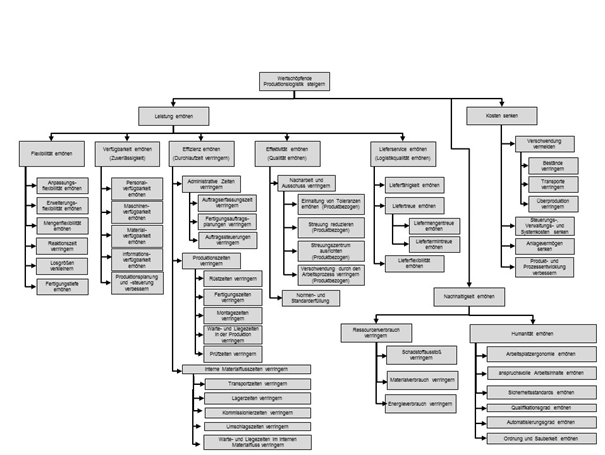
    The “empower” project aims to develop an interdisciplinary concept for methodical decision support when selecting alternative measures to increase the efficiency of production logistics processes in Upper Franconian SMEs. The concept is the basis for developing a software application that holistically supports the decision-making process. (© and further information: https://empower.fh-rosenheim.de/). An overview of relevant goals in production logistics can be found below.

  • Developing more and better alternatives (individually as well as in groups)

    Developing more and better alternatives (individually as well as in groups)

    Papers

    Siebert, Johannes; Keeney, Ralph L. “Creating More and Better Alternatives for Decisions Using Objectives”. Operations Research, September/October 2015, 63(5), 1144-1158, 1

    Siebert, Johannes. “Can Novices Create Alternatives of the Same Quality as Experts?”,  Decision Analysis (INFORMS) 2016, 13(4), 278-291

    Many individuals and organizations spend most of their effort evaluating alternatives without ensuring that the best possible alternative is to be chosen. Therefore, we analyzed how individuals and organizations can systematically create more and better alternatives to improve the outcome of their decision-making. The main idea is to use objectives as a stimulus in alternative creation (Keeney 1992). In cooperation with Ralph Keeney (Duke University, USA), I conducted five experiments. The participants created alternatives for essential decisions they were highly involved with. In summary, these experiments provided extensive evidence that using objectives for creating alternatives impacts the number and quality of alternatives created significantly. The results were used to derive a guideline for creating alternatives in critical decision situations.

  • Can Novices Create Alternatives of The Same Quality as Experts?

    Can Novices Create Alternatives of The Same Quality as Experts?

    Veröffentlichung

    Siebert, Johannes U. “Can Novices Create Alternatives of the Same Quality as Experts?”, Decision Analysis (INFORMS) 2016, 13(4), 278-291, https://doi.org/10.1287/deca.2016.0339

    The quality of alternatives is crucial for making good decisions. The process of generating high-quality alternatives can be enhanced by using decision makers’ objectives as prompts. This paper examines empirically the impact and interrelation of experience and the prompting with objectives on decision makers’ ability to create alternatives for an important decision. The study confirms with high significance that both experience and prompting with objectives enhance the quality of alternatives. We are able to show that all participants, irrespective of their experience, enhance the quality of their alternatives when they are prompted with objectives; i.e., the relationship between being prompted with objectives and the quality of alternatives is not moderated by experience. In contrast to gaining experience, prompting a participant with objectives can be utilized immediately without a long learning phase and is able to substitute for experience in certain decision contexts. Furthermore, we analyze how prompting with objectives affects the creation of alternatives. We find evidence that the relation between being prompted with objectives and the quality of alternatives is partially mediated by the number of objectives considered while creating alternatives.

  • Recommendations about decision-making for California ministry of transportation

    Recommendations about decision-making for California ministry of transportation

    The California Department of Transportation has a budget of approximately US$ 10 billion over four years for repairing the infrastructure of California’s freeways and freeway bridges. However, this budget is not sufficient to implement all the measures requested. A selection of measures to be carried out must therefore be made. Among other things, this is difficult because, for example, the representatives of the various Californian districts are demanding as many repair measures as possible in their own administrative area to improve their district’s infrastructure, create jobs, and ultimately be re-elected. Similar problems, for example, in allocating funds for broadband expansion, are all too well known in Germany. Clear and precise evaluation criteria are required for transparent evaluation and logical selection.


    In joint work with Ralph Keeney, I supported the California Department of Transportation in this selection decision in autumn 2014. In the first step, individual and group interviews were conducted with decision makers from the California Department of Transportation to identify relevant values and goals. In the second step, the goals were structured, and, in particular, the strategic objectives were calculated. In the third step, the goals were operationalized, i.e., made measurable. On this basis, the California Department of Transportation can evaluate all measures transparently and comprehensibly and make an appropriate decision about their selection.