
Tag: decision quality

  • MCI Professor Johannes Siebert Receives Prestigious SDP Award

    MCI Professor Johannes Siebert Receives Prestigious SDP Award

    International recognition honors outstanding contributions to data-driven decision-making, supply chain management, and societal impact | Award presented at the 32nd SDP Annual Conference at the University of Massachusetts in Boston

    Johannes Siebert, Professor of Decision Sciences, Behavioral Economics, and Supply Chain Management at MCI, has been honored with the “Inspirational Achievement Award” by the Society for Decision Professionals (SDP). This internationally renowned award was presented during the 32nd SDP Annual Conference at the University of Massachusetts in Boston, recognizing exceptional achievements in decision analysis and outstanding commitment to advancing the field.

    At MCI, Johannes Siebert conducts research and teaching in the field of decision analysis, with a strong focus on data-driven decision-making, behavioral economics, and multi-criteria methods. A particular emphasis lies on the role of artificial intelligence in decision processes, as well as on making decision quality measurable and trainable – key aspects in fostering innovation, digitalization, and future competencies in both academia and industry.

    “Decision science is at a turning point: artificial intelligence is transforming how decisions are made. However, at the same time, the importance of structured, value-focused decision processes has never been greater. This award strongly motivates me to further advance the field across research, practice, and teaching,” says Johannes Siebert.

    Johannes Siebert regularly contributes his expertise to international applied projects for both private and public sector partners, including initiatives in the energy, transportation, and pharmaceutical industries. His achievements have earned him multiple nominations for the Practice Award of the Decision Analysis Society. His excellence in teaching has also received international recognition, including a finalist nomination for the highly regarded European Award for Excellence in Teaching in Social Sciences and Humanities.

    MCI Rector Andreas Altmann adds: “This award highlights what MCI stands for: excellence in research, strong practical orientation, and active engagement with key societal challenges. Johannes Siebert exemplifies these values and strengthens MCI’s international reputation as a leading institution in decision sciences and management education.”

    Further links:

    MCI Professor Johannes Siebert Nominated as Finalist for European Teaching Award

    International recognition for MCI Professor Johannes Siebert

    Best Paper Award – Decision Sciences Journal of Innovative Education

    Think Beyond: Smart Decision Making and Great Ideas at TEDxInnsbruck – MCI Innsbruck

    Learning to Decide Wisely and Becoming Happy

    The original press release can be found here: https://www.mci.edu/en/media-en/news/7127-mci-professor-johannes-siebert-receives-prestigious-sdp-award
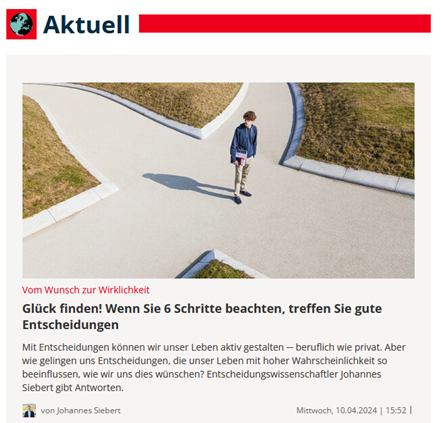
  • From wish to reality: Find happiness! If you follow 6 steps, you will make good decisions

    From wish to reality: Find happiness! If you follow 6 steps, you will make good decisions

    We can actively shape our lives through our decisions ─ both professionally and personally. But how do we make decisions that are likely to influence our lives in the way we want them to? Decision scientist Johannes Siebert provides answers.

    We often invest a lot of time and energy in important decisions. Nevertheless, sometimes we are dissatisfied with ourselves afterward. But when is self-criticism justified? What makes a good decision anyway?

    Only when we are clear about how we can make good decisions can we increase our own life satisfaction through our actions.

    First of all, a key point: the results of our decisions are not a criterion for their quality. Although we can influence the future, it is never entirely up to us how it turns out. There is always a residual uncertainty.

    Imagine we decide to travel to a destination known for its white sandy beaches and reliably sunny weather in the summer months. Then, we experience heavy rain showers, cold winds, or tanker accidents that pollute the beach.

    Did we make a wrong decision because of this? No, because we could neither foresee nor influence any of this when we made our decision.

    Instead, the quality of our decisions depends on six elements that are primarily within our own control and that interlock like the links in a chain. The following applies: the decision can never be better than the weakest link in the chain. It is, therefore, worth striving for the highest possible quality in all of the following six elements!

    Read the full article here (in German): https://www.focus.de/experts/vom-wunsch-zur-wirklichkeit-yes-we-can-mit-diesen-6-schritten-finden-sie-ihr-persoenliches-glueck_id_259842310.html

    Please stay current and not miss any of my contributions on FOCUS Online. For exciting insights and current discussions, follow me and network with me. I look forward to exchanging ideas with you! https://www.linkedin.com/in/johannes-siebert/

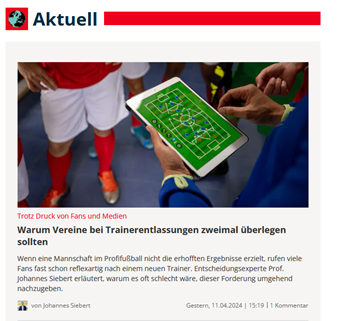
  • Despite pressure from fans and the media: why clubs should think twice when sacking coaches

    Despite pressure from fans and the media: why clubs should think twice when sacking coaches

    When a team in professional soccer fails to achieve the hoped-for results, many fans almost reflexively call for a new coach. In my article on Focus Online, I explain why it is often a bad idea to give in to this demand.

    A team is behind and needs two goals in the last quarter of an hour to turn the game around. In this critical situation, the coach decides to substitute a striker for a defender. The striker scores the two long-awaited goals and the team wins. Was the substitution of the striker a good decision by the coach? Many fans, commentators, and media clearly say “Yes!”. In the event of a defeat, they would have vehemently demanded the dismissal of the coach, whom they are now celebrating for his tactical foresight. In terms of decision-making theory, this reaction—although understandable at first glance—does not make sense.

    This becomes clear with a counterexample. Let’s assume Dietmar Hamann, who has long since ended his active career and works as a television pundit, is eligible to play and is sitting on the substitutes’ bench ready for action. He is substituted by the coach a quarter of an hour before the end of the game, an opponent’s clearance hits him on the back, and the ball bounces into the goal. A few seconds before the final whistle, there is a similar scene. Dietmar Hamann scores the redemptive goal. The team is victorious. Was it a good decision to substitute the “soccer pensioner” Hamann? Certainly not. But perhaps the coach could have made a decision that was more likely to win.

    At Bayern Munich, for example, Jupp Heynckes and Pep Guardiola would sometimes use the firm defender Daniel van Buyten as a tactical measure in the center of the attack, rather than replacing him with another striker. Van Buyten tied up two opponents, thus creating space for his teammates. Coaches are less celebrated by fans and the media for such measures. The reason for this is that the result of the decision is not directly linked to the coach’s decision, as would be the case if a substitute scored a goal.

    Read the full article here (in German): https://www.focus.de/experts/entscheidungsexperte-warnt-warum-vereine-bei-trainerentlassungen-zweimal-ueberlegen-sollten_id_259845761.html