Author: admin

  • From wish to reality: Find happiness! If you follow 6 steps, you will make good decisions

    From wish to reality: Find happiness! If you follow 6 steps, you will make good decisions

    We can actively shape our lives through our decisions ─ both professionally and personally. But how do we make decisions that are likely to influence our lives in the way we want them to? Decision scientist Johannes Siebert provides answers.

    We often invest a lot of time and energy in important decisions. Nevertheless, sometimes we are dissatisfied with ourselves afterward. But when is self-criticism justified? What makes a good decision anyway?

    Only when we are clear about how we can make good decisions can we increase our own life satisfaction through our actions.

    First of all, a key point: the results of our decisions are not a criterion for their quality. Although we can influence the future, it is never entirely up to us how it turns out. There is always a residual uncertainty.

    Imagine we decide to travel to a destination known for its white sandy beaches and reliably sunny weather in the summer months. Then, we experience heavy rain showers, cold winds, or tanker accidents that pollute the beach.

    Did we make a wrong decision because of this? No, because we could neither foresee nor influence any of this when we made our decision.

    Instead, the quality of our decisions depends on six elements that are primarily within our own control and that interlock like the links in a chain. The following applies: the decision can never be better than the weakest link in the chain. It is, therefore, worth striving for the highest possible quality in all of the following six elements!

    Read the full article here (in German): https://www.focus.de/experts/vom-wunsch-zur-wirklichkeit-yes-we-can-mit-diesen-6-schritten-finden-sie-ihr-persoenliches-glueck_id_259842310.html

    Please stay current and not miss any of my contributions on FOCUS Online. For exciting insights and current discussions, follow me and network with me. I look forward to exchanging ideas with you! https://www.linkedin.com/in/johannes-siebert/

  • Despite pressure from fans and the media: why clubs should think twice when sacking coaches

    Despite pressure from fans and the media: why clubs should think twice when sacking coaches

    When a team in professional soccer fails to achieve the hoped-for results, many fans almost reflexively call for a new coach. In my article on Focus Online, I explain why it is often a bad idea to give in to this demand.

    A team is behind and needs two goals in the last quarter of an hour to turn the game around. In this critical situation, the coach decides to substitute a striker for a defender. The striker scores the two long-awaited goals and the team wins. Was the substitution of the striker a good decision by the coach? Many fans, commentators, and media clearly say “Yes!”. In the event of a defeat, they would have vehemently demanded the dismissal of the coach, whom they are now celebrating for his tactical foresight. In terms of decision-making theory, this reaction—although understandable at first glance—does not make sense.

    This becomes clear with a counterexample. Let’s assume Dietmar Hamann, who has long since ended his active career and works as a television pundit, is eligible to play and is sitting on the substitutes’ bench ready for action. He is substituted by the coach a quarter of an hour before the end of the game, an opponent’s clearance hits him on the back, and the ball bounces into the goal. A few seconds before the final whistle, there is a similar scene. Dietmar Hamann scores the redemptive goal. The team is victorious. Was it a good decision to substitute the “soccer pensioner” Hamann? Certainly not. But perhaps the coach could have made a decision that was more likely to win.

    At Bayern Munich, for example, Jupp Heynckes and Pep Guardiola would sometimes use the firm defender Daniel van Buyten as a tactical measure in the center of the attack, rather than replacing him with another striker. Van Buyten tied up two opponents, thus creating space for his teammates. Coaches are less celebrated by fans and the media for such measures. The reason for this is that the result of the decision is not directly linked to the coach’s decision, as would be the case if a substitute scored a goal.

    Read the full article here (in German): https://www.focus.de/experts/entscheidungsexperte-warnt-warum-vereine-bei-trainerentlassungen-zweimal-ueberlegen-sollten_id_259845761.html

  • Realize your dreams through sound decision making

    Realize your dreams through sound decision making

    In an article in the FOCUS Online Expert Circle, I explain the biggest mistake made in decision-making and how to easily avoid it.

    The biggest mistake is that many people are content with the default decision-making situations and don’t actively engage with what they should (actually) be deciding on. It’s essential to think outside the box and (pro-)actively take control of our own decisions.

    And there is hope! Proactive decision-making is a skill that anyone can learn. A practical approach is to think through every decision-making situation with three key questions in mind:

    1. How can we best define decision-making situations?

    2. How can we identify the objectives relevant to a decision?

    3. How do we discover excellent options for action?

    I answer these and other questions in the interview. Read the full article here: https://www.focus.de/experts/fundierte-entscheidungsfindung-stellen-sie-sich-drei-schluesselfragen-um-traeume-zu-verwirklichen_id_259706293.html

    I also discuss the importance of being your own decision architect—a concept I explore in more depth in my TEDx Talk.

    English TEDxTalk: https://bit.ly/TEDxTalkSiebert

    German translation: https://bit.ly/TEDxTalkText

    Looking for more in-depth insights? My free online course “Proactively making smart decisions” is waiting for you with comprehensive material – ideal for a rainy February. Discover strategies for making smart decisions and expanding your horizons from the comfort of your own home. Register now and take the opportunity to expand your knowledge!

    Discover the course: https://imoox.at/course/smartentscheiden

    I was hoping you could stay up to date and not miss any of my posts in the FOCUS Online Expert Circle. Follow me and network with me for exciting insights and current discussions. I look forward to exchanging ideas with you!

  • MCI-Prof. Johannes Siebert wins prestigious Best Paper Award

    MCI-Prof. Johannes Siebert wins prestigious Best Paper Award

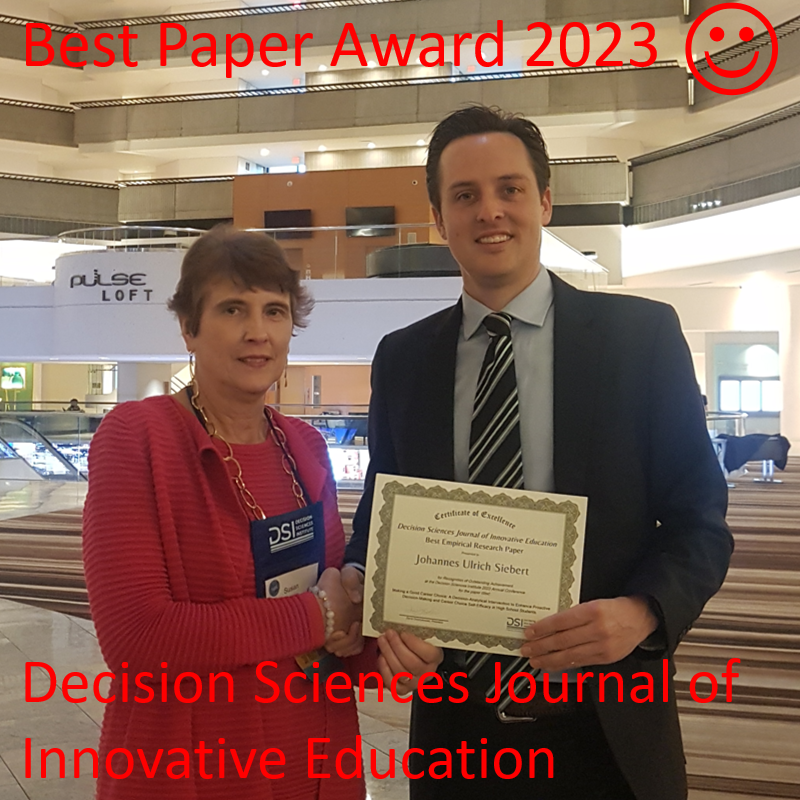
    We are delighted that the article “Making a good career choice: A decision-analytical intervention to enhance proactive decision-making and career choice self-efficacy in high school students” by Prof. Johannes Siebert, Dr. Nadine Oeser, and Dr. Maxi Becker was awarded the Best Research Paper 2023 by the renowned Decision Sciences Journal of Innovative Education. In previous studies, Siebert/Kunz/Rolf (2020, 2021) demonstrated the effectiveness of decision-making skills training for students and managers. Taken together, the studies allow the conclusion that proactive cognitive decision-making skills can be improved through decision-making skills training and, as a result, participants experience greater self-efficacy and are more satisfied with their lives. Motivated by these research results, Prof. Siebert wanted to investigate the effectiveness of KLUG-decision-making competence training in analogy to these studies.
    Further details can be found here: https://www.mci.edu/en/news-filter-en/193-studyprogram-news/news-business-management-en/5453-best-paper-award-decision-sciences
  • What is important when it comes to career guidance at school: researchers explain how best to support pupils in choosing a course of study or training

    What is important when it comes to career guidance at school: researchers explain how best to support pupils in choosing a course of study or training

    The drop-out rates among trainees and first-year students are high – on average, around one in four drop out again. Schools play a crucial role in providing career guidance. Prof. Dr. Johannes Siebert from the Management Center Innsbruck explains which mistakes should be avoided.

    You can find the full, excellent article by Lena Sterz from Campus Schulmagazin here: https://www.campus-schulmanagement.de/magazin/was-bei-der-berufsorientierung-in-der-schule-wichtig-ist

  • “KLUGentscheiden!” research project: empowering high school students’ study and career choices

    “KLUGentscheiden!” research project: empowering high school students’ study and career choices

    Making the right decisions in your own life is something that can be learned. The project “KLUGentscheiden!” at the University of Bayreuth shows: Young people who receive systematic training in decision-making skills shortly before leaving school consider their abilities and long-term interests far more thoroughly when choosing a course of study or vocational training than if they spontaneously follow their own wishes or simply trust the recommendations of others. In the coming weeks, the regional cooperation with selected schools that has been successfully established in the project will be further intensified and expanded.

    The coordinator of “KLUG entscheiden!” is Prof. Dr. Johannes Siebert, who set up the project at the University of Bayreuth and now teaches and researches at the MCI Management Center Innsbruck. Dr. Manuel Friedrich, head of the didactics of economics at the University of Bayreuth, is responsible for the didactics. The project is financially supported by the Adalbert Raps Foundation, the Rainer Markgraf Foundation, and the Upper Franconia Foundation and will be continued until the end of 2024 in cooperation with the University of Bayreuth.

    Decision-making training for students

    Many years of research on the theory and practice of decision-making form the basis for sound advice to teachers as well as for the design and implementation of workshops with students. A study coordinated by Siebert and published in “Decision Sciences – Journal of Innovative Education” proves the effectiveness of two-day workshops in which students from upper secondary level vocational schools in the region participated.

    The complete press release of the University of Bayreuth, written by Christian Wissler, can be found here.

    https://www.uni-bayreuth.de/press-releases/KLUG-entscheiden

  • Applying Decision Analysis to Diverse Domains: An Introduction to the Special Issue

    Applying Decision Analysis to Diverse Domains: An Introduction to the Special Issue

    Decision analysis (DA) is one of the key tools in operations research (OR). DA is particularly effective at mapping the real world to the model representation to enable the application of formal analysis. DA is a flexible modeling paradigm that has existed since the 1960 s, based on statistical decision theory, elements of utility from economics, probability theory, dynamic programming, and stochastic programming. It aims to identify an optimal course of action for decision problems with uncertainties that affect outcomes and values. Optimal here means expected-utility maximizing, which decision theory shows to be equivalent to following axioms of rationality given a set of beliefs.

    DA articles have appeared with some regularity in Interfaces (the predecessor to INFORMS Journal on Applied Analytics (IJAA)), with early applications focusing on policy and later ones on research and development in consumer products, pharmaceuticals, and oil and gas, quite naturally because these applications have distinct decision points when investments are continued or cut off (which is the meaning of the Latin root decidere). A 1992 special issue of Interfaces, “Decision and Risk Analysis,” highlighted applications that used rich representations of decision problems, such as influence diagrams as an abstraction of the decision tree, strategy tables to define complex alternatives, and practical techniques involving value-focused thinking and value hierarchies to implement multiattribute utility theory.

    All these developments help capture the knowledge and concerns of problem owners through model specification and judgment elicitation. In addition, DA models often interface with or subsume separate sophisticated technical or financial models. And DA representations aid in communicating the implications of models via, for example, tornado charts, portfolio diagrams, cumulative distributions, and risk profiles.

    In recent years, DA has added sophisticated computational abilities. Although to this day many DA applications ultimately reduce to decision tree calculations or the equivalent, software has improved to include modular graphical development that interfaces with spreadsheets and programming environments such as R and Python. Theory connected to DA also continues to advance, for example, group decision theory and extensions of utility theory to multiparty situations in which considerations such as equity are important. There is a substantial amount of adjacent computerintensive work on Bayes nets, machine learning, and inference. The science of elicitation has grown exponentially, ranging from increased understanding of judgmental biases, wisdom of crowds, and other ways to combine judgments of multiple experts to increased mathematical and computational sophistication, most recently advancing with copulas to represent correlations of different natures between variables. As seen in this issue, DA is increasingly well linked with other OR techniques, such as math programming for portfolio DA, leading to innovations in scholarship and practice. Thus, DA is an exciting field of interest to IJAA readers on its own merits but also as a field that can add value to other areas of OR.

    Saurabh Bansal, Jeffrey M. Keisler, Johannes U. Siebert, Karen E. Jenni (2023) Applying Decision Analysis to Diverse Domains: An Introduction to the Special Issue. INFORMS Journal on Applied Analytics 53(3):173-177. https://doi.org/10.1287/inte.2023.1163

  • About a literally life-changing decision: children, yes or no?

    About a literally life-changing decision: children, yes or no?

    The decision to what extent one wants to have children has significant consequences for the individual, the couple, and the family. That’s why it’s a decision that needs to be thought about carefully. In the Sunday edition of Die Presse, I give some advice for this particular decision. You can find Ms. Gabriel’s article, which is well worth reading, here: https://www.diepresse.com/6238448/kinderfrei-leben-ohne-reue

    I recommend making decisions proactively and taking your own destiny into your own hands as your decision architect. I explain this background in this #TEDxTalk: https://www.ted.com/talks/johannes_siebert_nudge_yourself_to_make_better_decisions, which has been well received and already has over 150,000 views and 5,000 likes; I am happy about every additional view and like😊.

    For even more interested on the topic, check out this free MOOC Smart Decisions (https://imoox.at/course/smartentscheiden). Those even more interested in deciding to what extent to have children will find further input in an interview in the Standard from August 2022. You can find the article here: https://www.derstandard.at/story/2000137561015/wie-werde-ich-mir-klar-ob-ich-kinder-will

  • Reducing the impact of misinformation and fake news

    Reducing the impact of misinformation and fake news

    New methods to effectively reduce the negative impact of misinformation and fake news on people’s opinions

    An investigation into Team Jorge’s activites has shown the sinister influence of misinformation and fake news on politics, society and the economy. Misinformation and fake news became a global phenomenon with the 2016 U.S. presidential election and the Brexit referendum, particularly because more and more people are using social media as a source of news without reflection. The use of artificial intelligence (e.g. chat GPT) in the generation and dissemination of misinformation and fake news will strengthen their influence in the future.The spread of misinformation and fake news on the internet and its consequences are being intensively discussed in the European Parliament. Nevertheless, so far, there is no clear agreement on how to reduce the influence of misinformation and fake news.

    “The problem with misinformation and fake news is that even if it is flawlessly identified as such, something still ‘sticks’ – the misinformation and fake news continue to influence our opinion, explains Prof. Johannes Siebert who researches and teaches at MCI | The Entrepreneurial School®. This phenomenon is called “belief perseverance bias“ and explains the great influence of misinformation and fake news on the formation of opinion and the decision-making behavior of many people. “There are numerous newsrooms and nonprofit organizations that identify misinformation and fake news. This very elaborate work helps reduce the influence of misinformation and fake news. However, these fact checks can only be a first step,“ adds Dr. Jana Siebert.

    The two researchers have been working on the methodological reduction of the belief perseverance bias in the context of misinformation and fake news in the project “PerFake“ funded by the European Union and the Czech Ministry of Education, Youth and Sports. The aim of the PerFake project was to contribute to reducing the negative influence of misinformation and fake news. Prof. Johannes Siebert and Dr. Jana Siebert developed two methods to reduce the belief perseverance bias and tested and optimized them in two experiments with numerous participants. The first results have been published in the prestigious journal PLoS ONE.

    Both tested debiasing methods showed promising results in reducing the belief perseverance bias. The debiasing method “counter-speech“ focuses on refuting the misinformation and fake news by clear counter-arguments. The debiasing method “awareness training“ generally informs the participants about the existence of the belief perseverance bias and how the bias works. Such awareness training could help increase society’s resilience to misinformation and fake news. Prof. Johannes Siebert explains how this can work in practice: “Let us assume you have received a piece of information, for example, you have heard a speech by a politician or read a post on social media. A fact check shows that it is fake news. Being aware of the belief perseverance bias should then help you realize that your original opinion may still be negatively influenced by the fake news and subsequently correct this bias.“ Dr. Jana Siebert adds: “It would, therefore, be desirable to educate the public about the belief perseverance bias and the way it works. For example, fact-checking organizations could complement their fact checks with a note informing about the belief perseverance bias. Such a note could significantly increase the effectiveness of fact-checking and society’s resilience to misinformation and fake news.“

    See also: https://www.mci.edu/en/news-filter-en/228-researchnews/4845-reducing-the-impact-of-misinformation-and-fake-news

    Source:

    Siebert, J., & Siebert, J. U. (2023). Effective mitigation of the belief perseverance bias after the retraction of misinformation: Awareness training and counter-speech. PLoS ONE 18(3): e0282202. https://doi.org/10.1371/journal.pone.0282202

  • How to finish a bachelor or master thesis successfully

    How to finish a bachelor or master thesis successfully

    Many students struggle to finish their thesis. In this weekend’s edition of the Standard, I share some tips on how you can outsmart yourself to finally finish your thesis or dissertation. However, the tips are applicable to almost any task you might be putting off. You can find Ms. Ostermann’s article, which is well worth reading, here.

    The basic idea of the extension of classical nudging is to be your own decision architect. I explain the background in this #TEDxTalk: https://www.ted.com/talks/johannes_siebert_nudge_yourself_to_make_better_decisions

    If you’re even more interested in the topic, you’ll find enough exciting material for the football-less, rainy pre-Christmas season in this free MOOC Smart Decisions (https://imoox.at/course/smartentscheiden) In the weekend edition of the Standard, I give decision-theoretically sound tips on how to finally finish your final paper